Note: The listings on this page are no longer current and should only be used for reference:
due to intractable events, losses and extensive damage to many plants these past seasons. For now, we are primarily taking orders from our Specimen Plant List [updated monthly], see the Andean Ethnobotanicals section.
Our retail lists are in need of significant revision. In the interim, we’re not taking any seed orders [except the few Specimen Seeds or Andean Crop Seeds]. You are welcome to make inquiries about plants on this page, but know our Specimen Plant List is the only reliable list to currently order from.
benkamm@monitor.net
This will continue until our retail stock has sufficiently recovered and our lists have been revised — we hope to update the retail web pages and resume shipping seed in the near future.
____
You can now support our conservation work, nursery renovations, research & writing,
by making a donation or becoming a patron of our endeavors.
See https://ssbp.betterworld.org/
or click here for tax-deductible donations via our new 501c3 fiscal-sponsor, Panax.
___
To assure we are distributing the highest level of genetic diversity, all of the plants we offer are grown from seed unless noted otherwise
Unless noted otherwise, seed packets contain 15-40+ seeds, often more (with very tiny seed like Gaultheria, Campanula, Nicotiana, etc., the seed count is in the hundreds). In the mid 1980s, at the impressionable age of 12, I was fortunate to be introduced to the vibrant ecological tapestry of Andean Peru during a family Summer trip. Since 1996 I have returned repeatedly to marvel at the unparalleled floristic diversity and explore the rugged mountains of central and southern Peru and adjacent Bolivia, studying the ethnobotany of the region, paying tribute to the land and people, and beginning a long term study of Trichocereus distribution and taxonomy (in conjunction with DNA studies being carried out by Dr. Martin Terry). The Andes are currently one of the most species rich plant-regions in the world, yet it is estimated that less than 10% of its forest remains. With this always in mind, responsible conservation minded collections of seed were made- preservation through distribution and propagation. We have a limited quantity of fascinating species still available along with plants grown from the seed. Purchases will help support future expeditions and the continual study of Andean plant life and ethnobotanical knowledge. See our Rare Plant List for additional offerings.
We have general recommendations for germination and cultivation. Many of these plants are new to cultivation and their needs may prove contrary to our suggestions. Please keep track of the collection numbers and your germination results and let us know! This way you can help contribute to the study and conservation of the remarkable plants of these regions.
Andean Collections Photos and Notes 2008
CD/DVD (PC or Mac) with 340 photos of plants, landscapes and archaeological sites from Lima Dept., Cusco and Puno-Peru. Tiwanaku, Isla del Sol, La Paz, and the Yungas regions of Bolivia. List of our seed collections of nearly 200 species with ethnobotanical notes and cultivation suggestions.
$10 postage paid in the USA, foreign orders add $2 shipping
Andean Collections Photos and Notes 2009
CD/DVD containing 350 photos including Peru’s Cusco region, the 3000 year old ruins of Chavin de Huantar, the Cordillera Negra & Blanca, intact highland Polylepis/ Buddleja forests, K. Knize’s nursery, and much more. Includes the list of our complete seed collections.
$10 postage paid in the USA, foreign orders add $2 shipping
Andean Collections Photos and Notes 2010
CD/DVD with 400+ photos from our Spring travels in Cusco, Peru including photos of the seldom visited lush Lares Valley, and Cochabamba, Bolivia where we examined the dryland cactus filled forests of the valleys, the endangered Polylepis forests of the higher mountains and the remote Incan archaeological site Inkallajta. Comes with a complete list of our seed collections with ethnobotanical notes and cultivation suggestions.
$10 postage paid, foreign orders add $2
Andean Collections Photos & Notes Complete Set
3 CD/DVDs of photos plus collection notes from all 3 of our expeditions to Peru & Bolivia 2008, 09 & 10.
$24 postage paid, foreign orders add $4
Andean Collections Photos and Notes 2014 & 15
CD/DVD of photos from the remote Apurimac region of Cusco Dept., Peru and Salta, Jujuy & Cordoba, Argentina Coming eventually!
Note: The listings on this page are no longer current and should only be used for reference:
due to intractable events, losses and extensive damage to many plants these past seasons. For now, we are primarily taking orders from our Specimen Plant List [part-way down the homepage & updated monthly].
For additional Andean cactus species see Cactaceae
Please list the BK or NL collection numbers along with the botanical names when ordering!
Abromeitiella lotteae
Bromeliaceae. Little 1–2″ rosettes of small triangular leaves, green with silver-gray flecking. Will eventually form large dense mounds to several feet across. Small tubular wine-red flowers with green tips. This rare red flowered species from southern Bolivia is exceedingly scarce in cultivation. The recent popular trend in genetic studies is to lump Abromeitiella into the genus Deuterocohnia, but there is plenty of valid reason to keep this unique genus intact. Z9b?
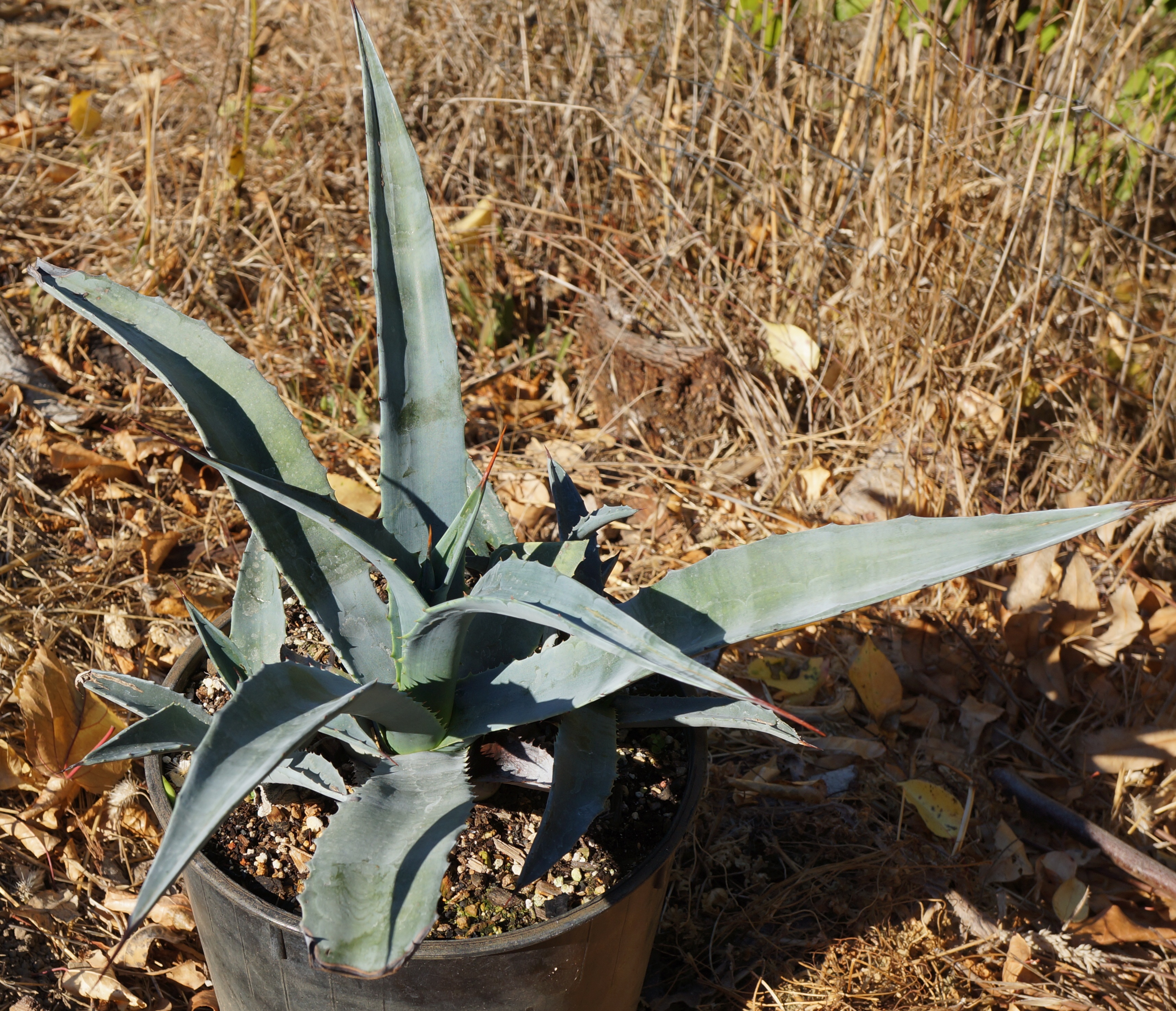
Agave cordillerensis NL52409
Agavaceae. Clusters of rosettes to 6-8’+. Leaves gray-blue with toothed margins. Flower stalks to 20’+ with curved or sometimes looped branches, yellow flowers. Botanists have dismissed this Andean agave as A. americana, G. Pino recently redescribed it as its own species based on its stouter leaves and radically different flower stalks. A beautiful and versatile plant. Widely planted as impenetrable hedgerows. Unknown in cultivation outside the Andes. N. Logan collection; Luribay, Bolivia, 8,000′. Z7b-8b?
Seed packet $4
Alnus acuminata BK10508.6 “Aliso” Lambran” “Andean Alder”
Betulaceae. Very attractive, fast growing tree to 30’+ with ovate leaves. Our seed collection from young trees growing with Polylepis tomentella ssp. incanoides, just past Koari on the way to Totora, Cochabamba, Bolivia, 10,000′. We have seen this species grow to majestic oak-like proportions. Highly versatile tree, fixes nitrogen in the soil, wood used for construction and leaves as a fertilizer. The leaves and flowers are made into tea that is considered a good overall tonic, useful for arthritis, colic and externally for wound healing. Leaves and bark produce a yellow and beige dye. This tree was once widespread along watersheds throughout the Andes up to 13,000′. Another keystone species, highly regarded by the Inca who encouraged its planting throughout their empire. A vital species for reforestation work and an excellent choice for permaculture and agroforestry systems. Z8a–9a
Alonsoa aff. acutifolia BK08519.13 “Aya aya”
Scrophulariaceae. Small shrub to 18″+. Racemes of unusual and very attractive flat faced orange flowers, a great ornamental. Seed collected on Incan terracing near Pisac, Cusco, Peru, about 11,000′. A tea of the plant is used for toothache and “susto”. Can be slow to sprout, 30+ days cold treatment. Z9a?
Anadenanthera colubrina v. cebil? BK151013.7 “Vilca”
Fabaceae. Nitrogen fixing tree 20–40’+ tall. Attractive oak-like bark, develops bizarre knobby protrusions on some older specimens. Feathery pinnate leaves. Cream colored spherical inflorescence. Flat seedpods 4–10″ long, large, round and shiny brown seed. Calilegua, Jujuy, Argentina, near 3900′. Abundant tree in this fairly lush Yungas forest, these were the tallest specimens we’ve seen and show a lot of variability. This population may intergrade with A. colubrina v. colubrina or even A. peregrina. Once one of the most important religious plants throughout the Andes. The earliest evidence of pyschoactive plant use is 4000 year old Anadenanthera seed found with puma bone pipes in northern Jujuy, Argentina. The seeds are used today in offerings and as an external head wash for headache, and reportedly as an abortificent. The astringent bark is used for the lungs and wound healing. A valued timber tree, the wood is very hard and dense with a beautiful reddish color. A leaf infusion is said to “bring about a period of fervor in cows”…which we’ll leave to your imagination. Sun, well draining soil. Drought tolerant. Z9b–10a sold out
Anredera diffusa? BK14508.1
Basellaceae. Succulent trailing vine to 24″+ long. Heart shaped leaves that turn dark purple-red in sun. Curious upright spikes with small pink flowers. Ullucus kin, may form edible tubers. Planted as an ornamental in Pisac and Cusco City. Reported wild in Arequipa, Peru. Edible mucilagenous leaves. Z8/9?
Anredera sp. BK08612.8
Scrambling or hanging succulent vine with pink stems 3–8′ long. Rounded pale green leaves. Slender spikes of tiny white-pink flowers are borne in mass at the leaf nodes. May produce a caudex with age. Growing on rocks and cliffs, north of Matucana, Lima Dept., Peru. An unusual, beautiful succulent plant. The leaves and roots might possibly be edible like other members of the genus and its close relative Ulluco. Seed can be slow to sprout. Z9a/b?
Anthopterus schultzeae HBG90758
Ericaceae. Epiphytic shrub with branches 3–10′ long. Narrow, densely arranged, elliptic leaves. New growth is reddish-bronze. Racemose inflorescence with 5–12 small, lantern-like flowers, pale yellow-green with a pink blush. Burgundy to black edible berries similar to a bilberry. A superb blueberry relative from the moist forests of Ecuador and north Peru between 2600–7500′. Grow like Macleania. Rooted cuttings. Z9b?
Apodanthera sagittifolia
Cucurbitaceae. From a large underground caudex grows annual trailing vines to 6’+ with arrow shaped leaves. Small yellow flowers and 2″ fuzzy oval fruit. Seed from Pehuen, Cordoba, Argentina. The fruit is said to be sweet but inedible? A must for caudex collectors. Z9b
Argemone subfusiformis “Argentine Prickly Poppy”
Papaveraceae. Herbaceous biennial to perennial to 2–4″. Deeply incised and spined blue-green leaves with white veination. 2″+ white flowers with rust and black centers. Holubec seed collection, Diamantes, Parana, Argentina. Alkaloid rich yellow sap with many medicinal uses. Z8?
Aristeguietia discolor BK08518.2“Asmachilcha”
Asteraceae. Attractive shrub 5–8′. Thick resinous lanceolate leaves, dark green on top and whitish undersides. Clusters of pale lavender colored flowers. Above Pisac, near 11,000′, Cusco Dept., Peru. Asmachilcha is a very important medicinal, useful for its powerful bronchodilating and mucus drying actions, very similar to Yerba Santa in California. Also burned to make ash for llipta. Z9b?
Aristolochia ringens
Aristolochiaceae. Robust evergreen vine to 10–30′. Dark green heart shaped leaves with pale undersides. Bizarre 4–5″ long flowers, yellowish with burgundy to purple veination, somewhat resembling a pelican’s head! Seed from Columbia. Host plant for the polydamas swallowtail butterfly. Evergreen in frost free regions, some sources say it will regrow from the roots in Z8b. Keep warm to germinate in 4–8 weeks.
Aspidosperma quebracho-blanco BK151015.1 “Quebracho”
Apocynaceae. Awesome oak-like tree 20–50′ with a crown of weeping branches. Thick cork-like bark, hard yellow-ochre wood highly valued. Whorls of 3 stiff, pointed, green leaves. Small yellow flowers. Native to the Chaco dry forests of Bolivia and Argentina. Seed from the Trichocereus terscheckii dry forests of south Salta, Argentina. The bark is used for lung conditions, fever, as an astringent, general tonic and very famous aphrodisiac. Contains several alkaloids including yohimbine. Drought hardy. Z9b/10a?
Aster sp.? BK09509.5
Asteraceae. Herbaceous plant to 2–3′. Clumps of dandelion-like, soft green leaves with white undersides. Large flashy flowers 3″+ across, bright red slender petals and orange centers. Growing on the hills around Chavin de Huantar, Ancash, Peru. High horticultural appeal. The actual genus remains elusive. Z9b?
Azureocereus viridis BK14513.1 (=Browningia viridis)
Cactaceae. Large columnar cactus to 15’+ tall. Candelabra stems to 10″+ diameter with a beautiful glaucus blue skin. V-notched, grey felted areoles with 1–2+ central spines 1–2.5″ long and 6–8+ radial spines 1/4–1″+ long. New spines are yellow turning grey with age. Tubular flowers to 3″ with dark brown-black bud scales and white petals. The dominant cactus of the dry forest along the Apurimac, 5000′. A truly gorgeous species, some clones were very sparsely spined while others were more heavily armored. Very rare in cultivation. Z9b/10a
Baccharis incarum BK08602.1 “T’ula”
Asteraceae. A pretty rounded shrub to 18″ tall and 24″ wide. Cream white flowers. Small serrated leaves, resinous with a spicy scent. Abundant on the dry sandstone hills of Isla del Sol, Bolivia, 12,500’+. Local shaman Lucio Ticono told us that boiling a handful of the plant makes a spicy brew that generates an “achuma like” effect. In northern Argentina it is used as a tea with antiseptic, carminative, antipyretic properties and a painkiller for muscle and bone aches. Infused in ethanol it is rubbed externally for rheumatism and inflammation. Studies show these southern populations of the plant to contain flavonoids and xanthines with strong antimicrobial and antioxidant actions. As far as we know the northern Bolivian populations have not been studied. Easy, sun and well drained soil. Should be drought hardy. Rooted cuts. Z8a and below
Baccharis sp. BK08528.2
Dense groundcover that forms green mats to 1″ high and 3′ wide. Waxy leaves, small white flowers. Exposed altiplano, near the ruins of Tiwanaku, Bolivia, 13,000′. We were told the plant is endangered. Grows to about 2″+ tall in cultivation, well draining mineral soil and sun. Rooted cuts. Z7?
Baccharis sp. BK14516.16
Beautiful, low growing plant under 12″ tall. Thickened, multi-angled, pubescent, blue-grey stems, 1″ lanceolate leaves with furry white undersides. Clusters of small white flowers at the stem ends that ripen into a cottony seed mass. Similar yet distinct from B. genistelloides: a widespread medicinal species. Steep grass slopes, about 9300′, above Apurimac. One of the prettiest Baccharis we’ve seen. Z9a?
Barbaceniopsis vargasiana BK14513.4
Velloziaceae. Dense clusters of slender, grass-like, stiff, leaves to 3″, forming mats to several feet across. Leaves are dark green with moisture but turn a dark purple-grey in the dry season. Lovely star-shaped pale pink flowers held on slender stems above the plant. Dry rocky slopes above the Apurimac River, Cusco Dept., Peru, near 6000′. Should be extremely drought hardy and even fire tolerant when established. Velloziaceae is a fascinating family rich in medicinal flavonoids. Will do well in any succulent collection. Z9b?
Begonia baumanii BK10509.8 “Killu killu” “Graniso t’ika”
Begoniaceae. Medium size tuber with beautiful round crinkled leaves to 6″ diameter. Large rose colored flowers on 2′ stalks. Growing on rock outcrops above the ruins of Inkallajta, Cochabamba Dept., Bolivia. This lovely endemic is reported to be used in rain rituals. The tubers are chopped and used to curdle milk for making cheese, said to impart an interesting flavor. Used as a mordant for dying. This species favors succulent or rock garden culture in captivity. The caudex like tuber will appeal to the lover of fat bulbous appendages on plants. New to cultivation! Z8/9?
Begonia boliviensis
Forms a discoid perennial tuber/caudex to 12″ across. Arching annual stems to 18″+, slender leaves and 2″ tubular orange-red blossoms draw hummingbirds. Native to the Yungas region of the Bolivian Andes. Introduced into cultivation the 1800s, it is parent of many of the modern hybrids. Well draining soil and part shade. A favorite for hanging baskets. Sprout seed like cacti. Z8a if well mulched
Begonia veitchii BK10428.9 “Achan k’aray”
Perennial caudex/tuber with large rounded annual leaves to 10″. Inflorescence to 12″ tipped with orange to pink flowers. Growing on rocks and banks above Rio Trapiche, 11,500′, remnant cloud forest near Lares, Cusco Dept., Peru. The plant is used in medicinal blends to treat flu, the tuber is reported to have contraceptive properties and three flowers in an infusion are said to be laxative. Best grown in a succulent soil mix, sun to part shade and a dry dormant period. Surface sow the tiny seed. Z8/9?
sold out
Blechnum aff. appendiculatum BK14512.4
Blechnaceae. Attractive small creeping fern. Rosettes of glossy imparipnnate foliage to 6”+ long, new fronds are an alluring rosy-red. Rocky slopes, shrub understory, near Capuliyoc pass, Cusco Dept., Peru, 9600’. May be drought deciduous. Easily grown, an excellent companion species. Z8?
Blechnum sp. BK10512.10
Unusual and distinct fern with a rosette of thick compound leaves on a small trunk to about 12″ tall, like a miniature cycad. Polylepis lanata forest understory and edges. Above Rio Lope Mendoza, Cochabamba Dept., Bolivia. We are pretty sure as to the genus, yet our fern knowledge is very spotty, but many years ago we saw Blechnum form small tree ferns at high altitudes in southern Peru. Z8?
Boehmeria? sp. BK14512.5
Urticaceae. Attractive low growing plant to 6″+. Rust colored semi-succulent stems. Compact, red-brown flower clusters at stem nodes. Stingless nettle-like furry leaves. Rocky slopes, near Capuliyoc pass, Cusco Dept., Peru, 9700′. Cute nettle-kin with edible leeves. Z9a/b?
Genus Bomarea
Alstroemeriaceae or Liliaceae. The Andes boasts 80+ species of these fantastic climbing lilies. Known regionally as “sullu-sullu” “orq-orqo” or “paicha-paicha”, some species are used to treat venereal disease, infertility, kidney pain and hemorraging. Many produce clusters of round edible tubers, 1″ or larger, and were once cultivated in pre-Columbian times. The young shoots are also eaten. Extremely showy clusters of multicolored tubular flowers and ornamental seed pods. Easily grown, well draining soil, sun to part shade. The vines die back and go dormant Winter to mid Summer.
Bomarea dulcis? BK10509.15
Perennial tubers with annual long arching stems with slender bluish leaves. Flowers not seen, but likely pink with green/yellow tips. The coveted Wichurea subgenus type that has arching asparagus or bamboo-like stems rather than twining vines. Might also be B. andimarcana. Growing amongst other shrubs near the Rio Machajmarca below the Inkallajata ruins, Cochabamba, Bolivia, 10,000′. Z8a or 9
Bomarea involucrosa? BK14510.7
Wichuraea subgenus, this is a non vining species with erect, bamboo-like stems to 6’+. Slender blue-green leaves. Dense terminal cluster of egg size seed pods with orange seeds. If identification is correct it will have nodding yellow-green tubular flowers to 3″ long. Peru boasts 80+ species of this fantastic lily. Some species are used to treat venereal disease, infertility, kidney pain and hemorraging. Many have an edible tuber, but the large tuber of B. involucrosa is considered noxious by locals and is not eaten. Growing near an ancient water shrine below Chakan, Cusco, Peru, 12,000′. Bomarea can have slow, erratic germination, from 2 months to 2 years. Scarifying the seed and warm/cold/warm periods help. Z8a?
Bomarea aff. macusanii BK08524.11
Twing vine with smooth lanceolate leaves to 2″+. The stems end in a rosette sheath of leaves from which an umbel of 1″ fire orange flowers is borne. Outer tepals red fading to orange, yellow striations towards the tip, green dot at tip. Inner tepals longer than outer, yellow fading to orange tip, small yellow point at very tip, red-orange midstripe. Green and red ovary and blue pollen. Similar to the rare B. macusanii but differs in the green dot on the outer tepals and the longer inner tepals. Possibly a new subspecies? Growing on rock and adobe walls near Lares, Cusco Dept., Peru, 11,000’+. Z8b/9a?
inquire for availability
Bomarea aff. ovata BK14513.17 “Sullu sullu”
Twining vine to 8’+. Green ovate leaves to 3″, lightly fuzzy undersides. Clusters of funnel shaped flowers to 1″ long, outer tepals rose to pink with a green tip. Inner tepals 1/4″ longer than outer, base yellow, tip green with a few dark spots, inner side heavily flecked with black striations. red-pink midstripe. Ovary and pollen green. A “lost” Incan crop, once cultivated for the edible tubers. Cloudforest, Sunchupata, Cusco Dept. Peru, 9700′. Z8
Bomarea rosea BK09509.4
Twining lily-vine with lanceolate green leaves to 3″, slightly fuzzy undersides. Umbel of 4–10+ trumpet shaped, 3/4″ flowers. Outer tepals lightly pubescent, pale pink to peach, tipped light green to turquoise. Inner tepals longer than outer, green with linear dark spots and a pink central stripe, sometimes outlined in dark brown. Green ovary and turquoise pollen. Attractive red-orange seeds. Growing on Senna shrubs on the hillside north of town of Chavin, Ancash Dept., 10,500′. This is the first time this rare species has been reported from this region. Z8b/9a
Bomarea sp. BK10509.3
Twining vine to 8’+. Large seed pods with sweet red seeds. Flowers unseen, but all Bomarea bear gorgeous clusters of tubular flowers, edible tubers, etc. Growing near the Incan ruins of Inkallajta, Cochabamba, Bolivia, 10,000′. Z8a/9a?
Bomarea sp. BK14515.3
Long vine growing 20′ into the tree canopy. Shiny lanceolate leaves. Very large, dense umbel of 20+ seed pods with shiny red seeds. Flowers unseen but we guess it may be the red flowered Bomarea sanguinea or one of its close kin. Cloudforest, Choquequirao, 9500′. Z9b?
Bomarea sp. ‘Andean Hybrids’
Open pollinated mix from our various Andean Bomarea collections. Should produce some very lovely and unique new hybrids. Z8?
Inquire for additional Bomarea species
Buddleja coriacea BK08528.1 “Colle” “Puna Kiswar”
Buddlejaceae. Of all the Buddleja, this species is undoubtedly the matriarch, the resplendent queen. Rounded bush or tree 8 to 30′. Stems densely packed with small leathery leaves, shiny on top, white underneath. Rounded clusters of pale orange to red flowers adorn the ends of the branches. From a distance it looks like an olive tree. Seed from the modern town of Tiwanaku, near the ancient ruins, Bolivia, over 13,000′. One of the few trees that is hardy up to 15,000’+, and a key species of the now mostly extinct highland Andean forest. Widely planted by the Inca and increasingly planted in the Andes for its beauty and many uses, though unknown in other parts of the world. Seems perfectly adaptable to low elevation cultivation. Flowers and stems are made into a tea for flu and coughs, pneumonia, photosensitivity, stomach ailments, utero tonic, and for post-partum health. An important dye plant. Drought tolerant and hardy to Z5b-6b if kept relatively dry.
inquire
Buddleja aff. stachyoides BK151011.5
Upright shrub 5–8′ tall. Large pubescent green leaves with white backsides. Thick erect flower spires to 12″+ with dark yellow blossoms. Somewhat resembles a shrubby mullein more than a Stachys. The leaves have a mild sweet balsam aroma. Podocarpus, Sambucus, Juglans cloudforest understory. San Lorenzo, Salta, Argentina, 5000′. Used for wound healing. Z9a?
Buddleja tucumanensis BK10512.2 “Yurak-wasa” “Yurayuraj”
Lovely shrub to 5–8′ tall. Downy, silver-grey, lanceolate leaves 4–8″ long with a refreshing fruity-citrus scent. Terminal spikes of rounded, yellow and orange flower clusters, sweetly perfumed. Growing on dry hillsides with Trichocereus riomizquensis and Cleome boliviensis, Totora, Cochabamba, Bolivia, 9,000′. Used for respiratory and cardiovascular issues, urinary troubles and to wash wounds. The essential oil of the leaves has shown insecticidal activity and is made up of 28 components including thujene, pinene, limonene, bergamotene, etc. We are pleased to introduce this unique aromatic species into cultivation. Should tolerate some drought. Surface sow, germinates in 3–8 weeks. Z8b/9a
Buddleja sp. BK14516.15
Shrub to 6′, large lanceolate leaves with pale undersides. Flowers not seen, but like most Andean Buddleja they should be somewhere in the yellow to red spectrum. Upper reaches of the dry forest high above the Apurimac, Cusco, Peru, 9000′. Z9b?
Cajophora horrida BK08517.11 “K’isa k’is
Loasaceae. A bizarre vine covered in stinging hairs like nettles. Triangular leaves with deep cut irregular margins. 1″+ bell-like orange flowers, very cool and distinct, like a pumpkin. The cone shaped fruit dehisce in a spiral arrangement when dry. Typically found scrambling over rocks or through bushes. Utilized much like nettles, made into tea for kidneys. Collected near Chinchero, Cusco Dept., Peru, 12,400′. Z8b?
Cajophora sp. SHL19.07.2012.2 ”Pica” ”Chachina”
Short rosettes of toothed, dark green, spiny leaves. Unusual and lovely, deep orange, 5 petalled flowers. Interesting seed pods dehisce spirally. The whole plant has a sting similar to nettles and is used medicinally in much the same way. S. Lipe collection from rock walls, Amantani Island, Lake Titicaca, Peru, around 13,000′. A choice rock garden plant. Z7/8?
Calceolaria luxurians
Scrophulariacae. Large rosettes of dark green rugose leaves. Branched inflorescence to 18″+ with dozens of bright yellow pouch flowers. Holubec collection from plants growing streamside, Aconcagua, Mendoza, Argentina, 11,200′. Very floriferous and easy to grow, surface sow seed. Z7?
Calceolaria umbellata ex F&W11439
Flattened rosettes of dark green leaves. Thin flower stalk held 5–8″ above the leaves, numerous intense yellow flowers with a large inflated pouch. Seed originally from Argentina. Rewarding from seed, blooms in just 6–8 months. Well draining soil and sun. Z7/8?
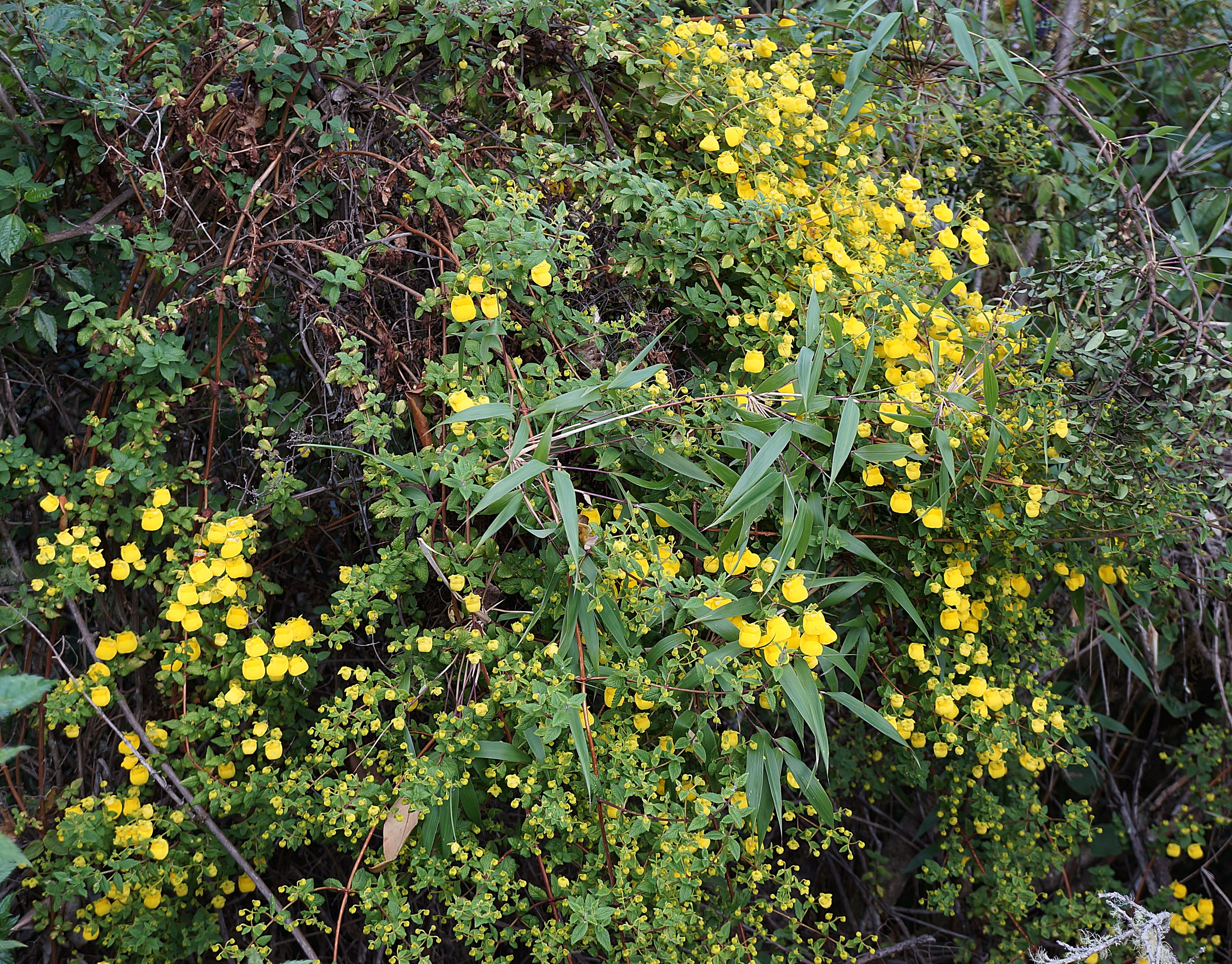
Calceolaria sp. BK14514.10
Large vine to 15’+. Small, dark green simple leaves. Cascading inflorescence with hundreds of lemon yellow pouch flowers, a waterfall of brightness! Growing through shrubs and trees, cloud forest Cusco Dept., Peru, 10,000′. Z9b?
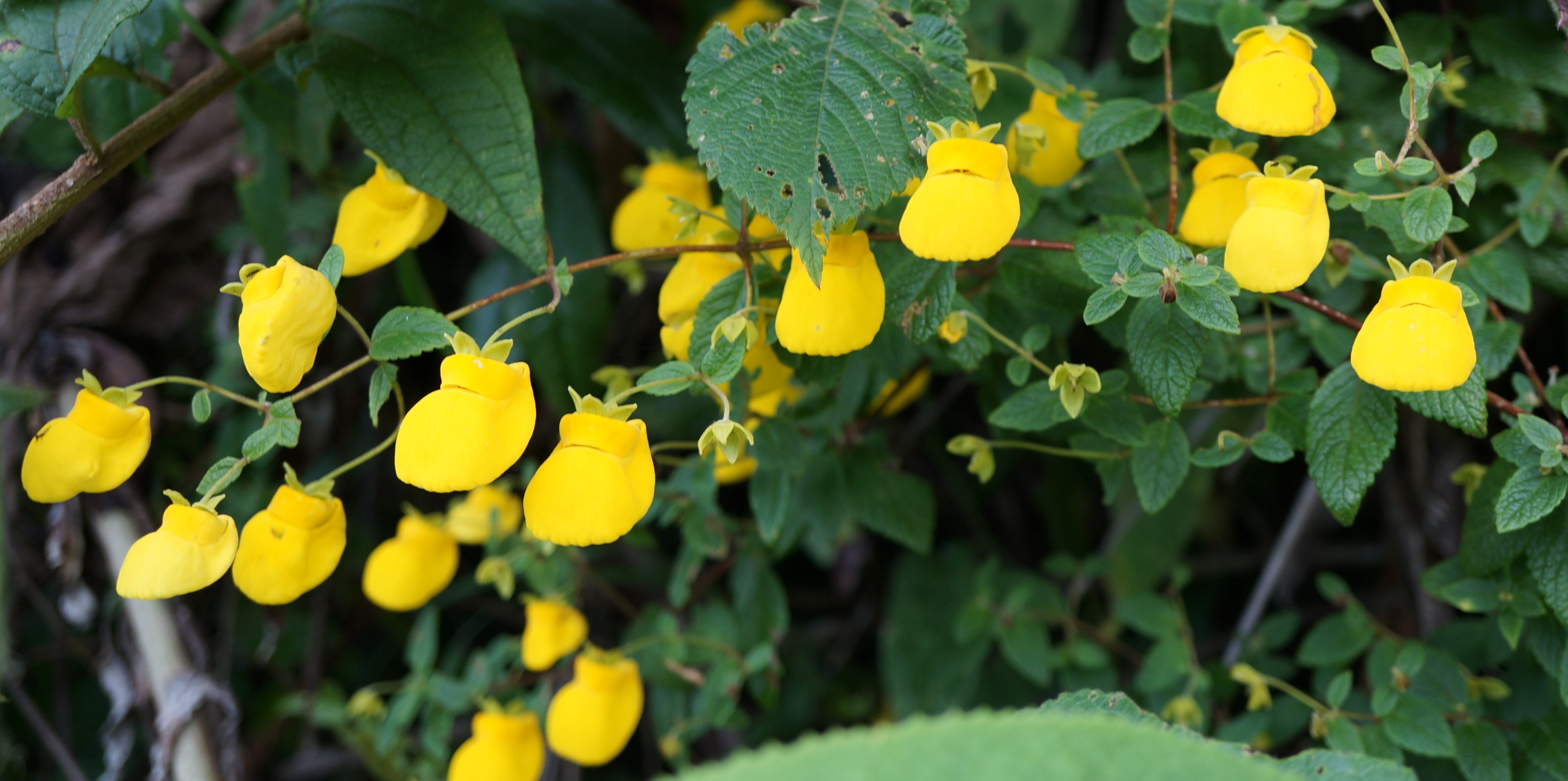
Calceolaria sp. BK14515.5
An adorable low growing plant 3–6″ high. Rounded furry leaves. Clusters of yellow pouch flowers. Exposed areas near cloudforest, south Peru. Should be somewhat tolerant of dry conditions and sun. Resprouts from roots after frost. Calceolaria are used in ethnomedicine for genito-urinary health and indigestion. Tolerates more cold than we expected. Resprouts from base after hard frost. Z9a
Seed packet $4
Canna sp. SHL130814.01 “Achira”
Cannaceae. Perennial rhizome with annual banana-like leaves and shoots to 5’+. Showy orange flowers. Seed used for jewelry. Beginning of Salkantay trek, Cusco, Peru, near 7000′. The rhizome and young seed pods can be eaten like other Achira. Knick and soak seed to sprout. Z8/9a?
Canna sp. SHL020916.01 “Achira Silvestre”
Large dark green leaves, flwoers not yet seen. Seed collected by S. Lipe in highland jungle/cloud forest on the Pilcopata to Paucartambo road, Manu, Peru near 6500′. This wild achira should have edible rhizomes and ornamental merit. Z9b?
Canna edulis “Achira” – see our Andean Tubers page
Capsicum eximium “Ulupica Pepper”
Solanaceae. Perennial shrub 2–3′ tall. Purple star flowers. 0.5″ or smaller round fruit turn red when fully ripe. La Paz Dept., Bolivia. The famous ulipica, thought to be the progenitor of all Capsicum. This is a very hot pepper with a distinct sharp flavor. Usually used green. About 80 days from seed to harvest. Self-incompatible, 2 or more plants for fruit set. Needs sun and warmth. Best germination with GA3 treatment. Z9b?
sold out
Capsicum chacoense “Tova” “Covincha Pepper”
Upright 2’+ shrub. White flowers, erect triangular red fruit to about 1″ long. Another rare wild chile pepper, native to mid elevation southern Bolivia, adjacent Argentina and Paraguay. Medium heat, good flavor. Very drought tolerant, 80–120 days to maturity. Best germination with GA3 treatment. Z10
Cavendishia axillaris HBG96079 “El Macho”
Shrub to 2–4′. Deeply veined, dark green suborbicular leaves to 3″+ densely arranged along the stems. The unique inflorescences occur at the leaf axils–clusters of rose-pink bracts and numerous small, bottle shaped, white-pink to yellow-white flowers. Rounded edible blue berries. A terrestrial to epiphytic denizen of the cloud forests of Costa Rica to northern Columbia up to 9000′. We have several clones available, rooted cuts. Z9b?
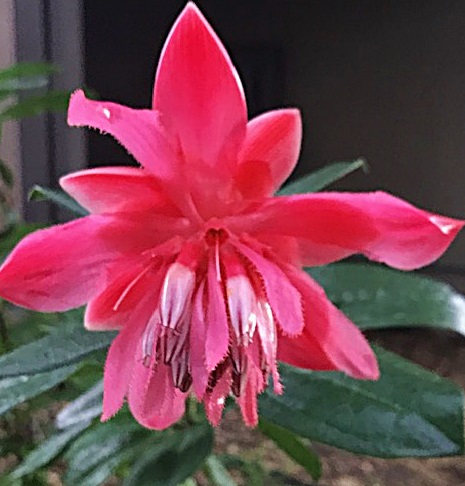
Cavendishia adenophora “Quereme Rosa”
Ericaceae. Evergreen shrub to 6’+. Thick, oblong or obovate leaves to 6″. New growth is pink-red to bronze. Large terminal clusters of up to 25 tubular flowers, pink with dark rose stripes surrounded by pink bracts with rose frills along their margins–unbelievably showy and unabashedly erotic! Large edible berries. Cordillera Occidental cloud forest of Choco and Valle Depts., Columbia, between 2200–6500’+. Considered the most gorgeous Cavendishia species, local legends tell of the alluring power of its beauty. Endangered due to overharvest for “love magic” and for sale in local flower markets. Prefers filtered light and moist acidic soil. Rooted cuttings from several clones. Z9b/10a
Cavendishia capitulata HBG92102
Multibranched shrublet 1–3’+ high with a thickened stem base to 6″ diameter. Small obovate leaves, new growth bronze. Flower clusters with reddish bracts and 3–6 tubular purplish flowers with white tips. Round berries. Often occurs as an epiphyte, wet tropical forests and cloudforests of Costa Rica, Panama and Columbia up to 9000′. One of the most endearing and diminutive Cavendishia, no less lovely for its size. Rooted cuttings. Z9b?
Ceratostema rauhii Rauh68468
Ericaceae. Epiphytic blueberry kin. Forms curtains of long pendulous stems to 6′ with whorls of densely arranged, lime green, pointed leaves that are soft and fuzzy. Red pink tubular flowers with recurved tips bloom along the stems. This unique species is known only from a small area of cloudforest near 7000′, Lambayeque, Peru. Perfect for hanging baskets, the eco-hipster’s ultimate beaded curtain! Acidic soil and filtered light. Rooted cuttings. Z9b/10a?
Cheilanthes bonariensis BK10426.3
Pteridaceae. Attractive xerophytic fern with erect grey to silver blue fuzzy leaves to 6″+. Growing on rocks, descent from Pumamarca, Cusco Dept., Peru, 10,800′. May be chewed like coca leaf, other Cheilanthes and Polypodium ferns have been reported as coca substitutes. These rock ferns can be grown like succulents and are drought tolerant, the fronds curling up when dry. Z8a/b
Chenopodium pallidicaule ’La Paz’ “Kaniwa” “Iswalla Hupa”
Chenopodiaceae. Weedy annual 1-2′ tall. A semi-domesticate, cultivated in the altiplano regions of Peru and Bolivia. Grows where its close kin quinoa and kiwicha (or any grain) will not-dry, salty, and cold regions over 13,000′. The tiny seed is extremely nutritious, about 16 percent protein, even the leaves are protein and calcium rich. Unknown outside the Andes, worth experimenting with as a crop. Heirloom variety with blackish seed, grown on the altiplano of La Paz, Bolivia. Z6?
Chenopodium pallidicaule ‘Cochabamba’ ”Kaniwa” “Iswalla Hupa”
Heirloom strain with reddish-brown seed from Cochabamba, Bolivia. Z6?
Chenopodium quinoa ‘Quri’ “Gold Quinoa”
Rare heirloom Peruvian quinoa with pale yellow to deep orange seed. Annual stalks 5-8′+ tall, the largest quinoa we’ve seen. The flower heads are a medley of color, from yellow to pinks and pale purples. A long season variety. “Quri” is the Quechua word for “gold.”
Chenopodium quinoa ‘Supha Aqu’ “Quinoa”
3–4′+ tall annual. Rounded flower clusters and seedheads. The stems, leaves and flower panicles range from green-blue to pink-purple. Fat, sand colored, nutritious seeds. A short season heirloom quinoa from Aymara communities in northern Chile. Should be adaptable to arid climates.
Chenopodium quinoa v. melanospermum BK10505.2 “Ajara” “Quinoa Negro”
Heirloom Bolivian quinoa with shiny blackish seed and rich flavor. Bolivia is the world’s major producer of this extremely nutritious and delicious grain. Seed from Cochabamba, Bolivia.
Commelina fasciculata BK09509.3 “Sara-sara”
Commelinaceae. A gentle sprawling plant to 12″+. Slender leaves and unmistakable shiny deep-blue flowers with 3 petals and yellow anthers. In many regions the new shoots of Commelina are eaten. This lovely plant was common around Chavin de Huantar, Ancash Dept., Peru, growing with Trichocereus and Borzicactus fieldianus . Easily grown, sun to part shade. Z9b?
Coriaria ruscifolia BK08524.16 (=Coriaria thymifolia)
Coriaraceae. Leafy shrub to about 3-6′. Long arching leaves made up of may small leaflets. Drupes of tiny purpleblack berries, like a string of jewels. Collected just above Lares Hotsprings, Cusco Dept. Peru, about 11,000′. Nitrogen fixing plants, often considered poisonous. Berries of Ecuadorian populations are used to induce a feeling of flying. Distinct from the Chilean form of this species we offer. Beautiful red leaf stems. So far they are only tolerant of a little frost, may be hardier when mature. Z9a-b
Coriaria ruscifolia v. microphylla? BK09430.4 (=Coriaria thymifolia) “Mio-mio”
Small leafy shrub to about 2′. Arching, fern-like leaves made up of may small leaflets. Drupes of tiny purple-black berries. The plant and seeds are more diminutive than what we collected in 2008 at Lares, may be closer to the original C. thymifolia v. microphylla. Nitrogen fixing toxic medicinal. Source of a purple dye. Collected at 8,800′, Cusco Dept. Z9a-b
For additional Coriaria species see our Chilean offerings
Corryocactus brevistylus BK09424.1 “Sanky”
Cactaceae. Attractive Trichocereus peruvianus-like columnar cactus from southern Peru. Stems 10–20′ tall, spines up to 9″ long! Yellow tubular flowers and softball size fruit. Fruit purchased at one of the large traditional markets in Lima city. The flesh of the huge fruit is amazingly sour, as acidic as a lemon. Considered a liver and kidney tonic. We blended the pulp with a little honey-water to make a delicious and refreshing sanky-ade. More tolerant of cold and aridity than any lemon tree, could substitute in areas where lemons can’t grow. Z8b/9a
Corryocactus melanotrichus RCB009 “K’usa k’usa”
Slender columnar stems to 6–8′+ tall, well armed with long spines. Endowed with Purplish flowers and fat round fruit to over 3″ with a delicious sweet-sour flesh, reminiscent of kiwi. Seed collected along the Rio Abajo, La Paz, Bolivia, 11,750′. The fruit is said to be useful for inflammation and as an analgesic. Cut sections of stem, along with several other spiny cacti, are sold at the witches market in La Paz for use in misa offerings and as a wash for good luck. A hardy species worth growing for the fruit. Z8b/9a
Cucurbita maxima ssp. andreana “Zapallito Amargo” “Wild Squash”
Cucurbitaceae. This is the wild progenitor of many of our winter squashes. Fast growing annual vine. Big yellow-orange flowers swell into ovoid fruit to 5″, dark green with pale green stripes. Bitter inedible flesh. Seed from wild plants, Bahia Blanca, Argentina. Over 4000 years ago people in South America selectively bred this species into the diversity of the hard squash we enjoy today. The vapor of the steamed fruit is used as an expectorant and seeds as a purgative and vermifuge. Ornamental, of interest for cucurbit breeding and historical curiosity. Z9
Cyclanthera explodens BK09506.2 ”Achukcha” “Wild Caigua”
Cucurbitaceae. Clambering tendrilled vine with 3-lobed leaves, small yellow/white flowers and 1–2″ inflated fruit covered in small prickles. When the fruit is fully ripe it “explodes”, launching the seed up to several meters. This wild caigua is often seen for sale in the local markets, being used for food and medicine the same way the cultivated species is. The small fruits are excellent cooked in soups or stir-fry. From seed collected in Huaraz, Ancash Dept., Peru. Will perennialize in mild climates, otherwise grow like an annual cucumber, giving the vine plenty of room. Z9b
Cyclanthera pedata “Caigua”
Tendrilled annual vine with palmate leaves and peculiar inflated green fruit to 6″, often lightly prickled. A popular food in South America, another “lost” Incan crop, with a flavor similar to artichoke. The hollow fruit is cooked and eaten, usually stuffed with vegetables and meat or added to soups. The flesh is also an important medicinal, being a strong anti-inflammatory and flushing cholesterol from the body. The whole plant is considered a brain tonic. A delectable veetable hat deserves much wider cultivation. Grow like cucumber. Z9b
Cyclanthera pedata BK10505.1 – Heirloom strain from Cochabamba, Bolivia. Produces very well for us.
Cyclanthera pedata ’Tarija’ – Heirloom strain from Tarija, Bolivia. Vigorous vine, smooth skinned fruit.
Cypella herbertii
Iridaceae. Bulb with upright pleated leaves and flower stalks to 2–3′+ tall. Showy golden goblet flowers with rust and purple inner markings. Argentina, Paraguay, Uruguay and south Brazil. One of the easiest species to grow and very floriferous all summer. Bulbs may be edible. Can bloom in 1 year from seed. Well draining soil and sun. Z8a
Cypella herrerae? BK10430.1 “Michi-michi”
Grass-like leaves to 18″. Large iridescent blue flowers with yellow splotches, a true jewel of a blossom. Near the Wari ruins of Pikillacta south of Cusco City, Peru, 10,700′. The bulb of some species is edible and used medicinally for cough and inflammation. Cold stratify, slow germination over 3-18 months. Z8/9 sold out
Cypella peruviana BK08525.5
Pleated linear leaves, flower stalk to 2′. Bulbous Iris relatives with large gorgeous flowers with a fruity sweet scent. Bright yellow blooms with a center of mottled red-brown striping. The inner petals have a furry stripe edged with white and metallic blue. Rock outcrops in cloudforest, outside Aguas Caliente, Peru, 7,500′. Used for cough and inflammation. There’s reports of the bulbs being edible. Z8b?
Cyphomandra betacea “Tree Tomato” “Tamarillo”
Solanaceae. Fast growing shrub from 6–20′ tall, usually with a single upright trunk. Large heart shaped leaves. Self fertile white flowers. Egg sized, yellow/orange to deep red edible fruit. A cultivar from the mid to low elevation Andes, unknown in its wild state. Grown throughout the subtropics and on a commercial scale in New Zealand for over 70 years. Prolific fruiter, mature trees up to 40+ lbs of fruit a year. The fruit has a bitter skin, but the flesh varies from sweet to acid, similar to a tomato or tomatillo. Typically the yellow or orange fruit is sweeter and fruitier while the red is more acidic. Z9b
Datura stramonium? SHL04.07.2012.2
Solanaceae. Annual species with fragrant white trumpet shaped blooms, purplish inside. Spiny seed pods. Likely introduced to the Andes from Mexico. Rich in toxic medicinal tropane alkaloids. S. Lipe collection, Pisac, Cusco, Peru. Z9?
Deuterocohnia longipetala
Bromeliaceae. Puya-like multiheaded mounds to 2–4′ made up of rosettes of recurved, toothed, silver leaves. Erect branched inflorescence with tubular yellow flowers. Seed from the dry valleys of northern Peru where it occurs up to 5000′. Another beautiful pineapple relative. Sun and drought hardy. Z9b
Deuterocohnia sp. ‘Rio Balsas’
Bromeliaceae. 2’+ rosettes of recurved silver-green leaves. Said to be distinct from D. longipetala, we’ll need to grow the plants to maturity to learn more. Seed collected along the biodiverse Rio Balsas, north Peru. Z9b/10a
Dioscorea sp. BK08517.20 “Andean Yam”
Dioscoreaceae. Perennial rounded caudex to 4–6″+ diameter. Annual vine to 5′+ with slender heart shaped shiny leaves. Strings of tiny yellowish flowers. Dry scrub, Moray, Cusco, Peru, 12,000′. The Andes have dozens of species of unusual Dioscorea, some are medicinal and some edible. With age these plants will appeal to caudiciform collectors. Normal succulent culture. Easy houseplant. Z9a/b?
Dioscorea sp. BK08605.3 “Yungas Yam”
Medium sized annual vine to 8′+. Very Slender heart shaped leaves, clusters of yellowish flowers. Long cylindrical brown tuber/caudex. Found growing on dryland shrubs, Anandenanthera colubrina trees, and the bizzare columnar cactus Yungasocereus inquisivensis. Near the vast Tiwanaku/Incan ruins of Pasto Grande, Sud Yungas, Bolivia, about 6,000′. The tubers of this lovely species look similar to cultivated yams, but we can make no claims to edibility. Worth further study. Seed has sprouted irregularly for us over a 2 year period, so be patient! Z9b?
Dioscorea sp. BK10509.2 “Andean Yam”
Vine to 10’+, large heart shaped leaves. Elongated tuber/caudex. Growing on Alnus trees near the river below Inkallajta, Cochabamba, Bolivia, 10,000′. An attractive yam species, we wish we knew if it is edible! Z9a–9b?
Disterigma rimbachii HBG95935
Ericaceae. Beautiful multibranched shrub to 1–2′. Small, spirally arranged, oval leaves clothe the stems. New growth is deep red. Rose-pink tubular flowers borne along the stems. Light indigo-purple berries, sweet and juicy. Blueberry kin endemic to the low mountain forests and cloudforests of Ecuador from 2500–10,700′. Filtered light, well draining, moist, acidic soil. Rooted cuttings. Z9b?
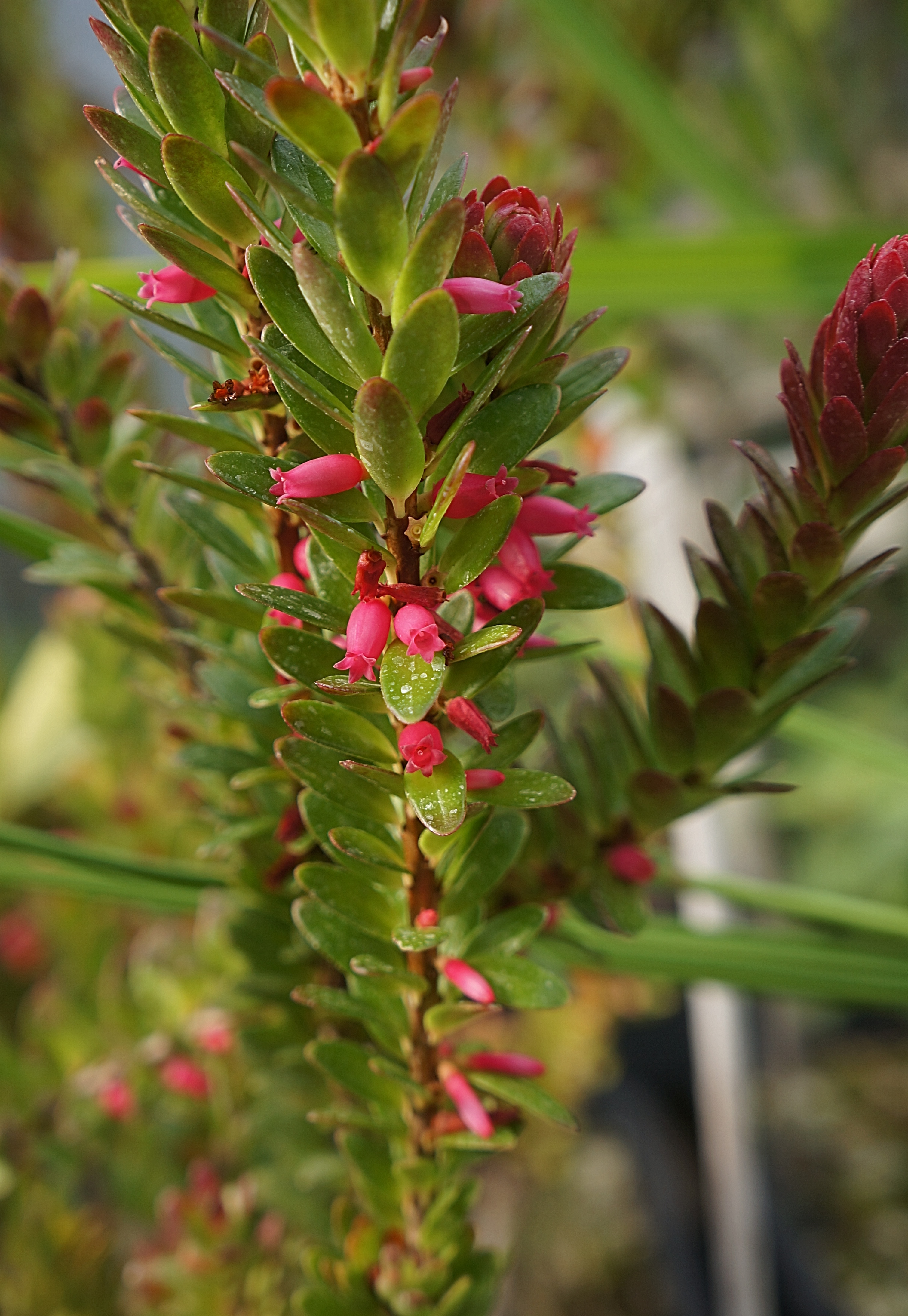
Dyckia sp. D30-22
Bromeliaceae. Clustering species with individual rosettes to 12″+. Slender recurved leaves, olive-green developing a silver frosting with age. Red to black marginal thorns. Upright inlforescence to 3’+ with vibrant orange flowers along the stalk. Possibly a new species from Bolivia. Z9a/b?
Echeveria ballsii
Crassulaceae. Short stemmed, clustering rosettes of slender dark green leaves with red-purple margins and speckles. Peach-red flowers with yellow interior. This rare species from the cloudforests of Columbia was thought to be extinct in the wild until recently rediscovered. This clone collected by Robert Wellens, Masquera, Cundimarcana, Columbia. Prefers a bright, cool environment. Z9b
Echeveria chiclensis BK08612.6
Large rosettes to 10″ or more. Slender leaves are blue-green, blushed an amorous purple or red. Deep-yellow flowers with orange hues. Crassulaceae expert Guillermo Pino took us to see this lovely species growing amongst scrub next to the embankment on the side of the road near Chicla, Lima, Peru, 12,000′. Z8b–9a and lower
inquire
Echeveria chiclensis v. backbergii BK08612.2
Blue-grey rosettes to 6″. Slender pointed leaves, yellow flowers blushed orange. Similar to some of the California Dudleya. Growing on rocks, often is association with Trichocereus peruvianus. Near Matucana, 8,600′, Lima Dept., Peru. Echeveria are used medicinally in Peru for cataracts and earache. Sprout like cacti. Z9a and lower
Echeveria cuscoensis BK09426.1
Beautifully sculpted, pale blue-grey rosettes to 6″, clustering with age. Orange-yellow flowers on stalks to 12″ long. Growing on rocky cliffs on the north side of the upper Kitamayo Gorge, 11,000′, Pisac, Cusco Dept., Peru. We helped to map the ecological distribution of this lovely plant and recently co-authored with G. Pino a paper describing it as a new species. Z9a/b
inquire
Echeveria eurychlamys
Single dense rosettes to 3–6″. Wide leaves, light green-blue with a white to pinkish blush. Inflorescence initially nodding then erect, covered in rounded bracts, yellow to salmon colored flowers. Rocky areas of Cajamarca Dept., Peru between 6,000–11,500’+. One of the most attractive Andean Echeveria. Prefers strong, bright light and a very porous soil. Z9a–b
Echeveria laresensis BK10428.10
2–4″ rosettes of pale-blue diamond shaped leaves, eventually forms clusters to 10″+. Horizontal flower stalks bearing reddish flowers with yellow tips. Growing with Tillandsia, Peperomia sp., succulent Oxalis sp., and ferns. Steep mountainside across from Lares Hotsprings, 11,300′. We discovered this species in 2008, believing it to be E. decumbens, taxonomical work we recently authored with G. Pino has shown it to be a brand new species. Known by the Quechua name “loraypo”, the leaf juice is highly valued for treating cataracts and earache. Z9a/b
Echeveria oreophila Bauer & Kimnach 10 “Pinpin”
Thick, branched stems 3–6″+ long, crowned with 3–5″+ diameter rosettes of thick, glaucus blue-green leaves with reddish margins. The plant turns purplish in strong light. Pale pink flowers. This clone is the holotype collection from Cumbemayo, Cajamarca Dept., Peru near 11,500′. A popular ornamental in the towns near where it occurs. Used medicinally for earache and eye troubles. Said to be the easiest Andean species to grow. Z9b.
Echeveria westii BK08521.7 “Loraypo”
Beautiful red-purple to bluish compact rosettes, a small sculptured jewel. Orange flowers. Growing on rock outcrops near Ollantaytambo, Cusco, Peru. Originally described by Walther in the 1950s, but exceedingly rare in cultivation. Used medicinally for cataracts and earache and figures prominently in the weavings of some Quechua communities in the region. Z9b?
inquire
Echeveria sp. nova BK09514.1
A very distinct plant. Forms 6″+ rosettes of slender leaves with a central furrow, dark green to dark purple-green or even black in color, sometimes with red-brown highlights. Peach colored flowers. Growing on steep rock cliffs with Tillandsia species and an impressive population of serpent-like Trichocereus peruvianus, Fortaleza Canyon, on the descent from Conacocha and well before Cajacay, Ancash Dept, about 10,000′. Very clearly an undescribed species, G. Pino will eventually name and publish it. Z9b
Inquire for additional Echeveria species
Elaphoglossum cuspidatum? BK14514.12
Dryopteridaceae. A gorgeous fern with 2″ wide by 12″+ long linear leaves, green to glossy silver-green with beige undersides, black when sporulating. Some leaves have wavy margins and twist and curl as they age. Growing amongst Hesperomeles ferruginea, Distergima sp., and Baccharis species, cloudforest far above Apurimac, Cusco, Peru, 10,500. Z8/9?
Elaphoglossum engelii? BK10428.4
A fern with clusters of upright linear leaves to 5–8″, larger at lower altitudes. Front side of the leaves is grey-green and the back side is black with the spore mass making an attractive contrast. Just above Huacahuasi, Cusco Dept., Peru, 12,700′. Growing with Brachyotum shrubs and a small Vaccinium sp. Z7–8?
Elaphoglossum aff. piloselloides BK14512.1
Small fern that forms flattened colonies of 1″ spathulate green leaves with red-brown to black hairs. Unusual beige sporophyllic leaves are held just above the plant and look surprisingly like a toothless venus-flytrap, the inner surface contains the sporangia that turn black when ripe. We first saw this plant in a cliff crevice in 2009 and mistook it for a carnivorous plant! The current accession is from a few kilometers outside Cachora, Cusco, Peru, 9,300,’ where we were able to recognize it as a fern. Part of our confusion was due to the fact that in both locations the plant was growing with subsurface water seeping–a habitat that many carnivorous species prefer. The current location was beginning to dry up, suggesting the plant tolerates seasonal dryness. Z9/10?
Ephedra americana BK09509.11 “Pinku pinku”
Ephedraceae. Upright leafless stems to 3–4′. Sweet edible red fruit, these plants had some of the largest and by far the highest density of fruit of any of this species we’ve seen. An important medicinal used for kidney and liver, as a blood cleanser and urinary tonic, digestive aid, antiseptic, for bruises and fractures, and for fever and arthritis.Growing with a lovely stand of Trichocereus santaensis, west side of the Santa River, near Olleros and the ancient road that connects the Callejon de Huaylas with Chavin. Ancash, Dept., Peru, 11,000′. A great drought hardy choice for the edible landscape and companion plant for your Trichocereus. Z8?
Ephedra aff. rupestris BK09511.2
Dwarf species with individual stems 1–6″ tall, tasty red berries. Forms dense mounds to 1–2′ across. Distinctly different than the high altitude miniature species we collected in 2008 in the Cusco region. Open puna grassland and rock outcrops, growing with Oroya borchersii, Matucana spp. and Austrocylindropuntia floccosa. 13,200′, Cordillera Negra, Ancash Dept., Peru. Perfectly adaptable to low elevation cultivation, though it does not grow as compact. One of our favorites. Z5–6?
inquire for plants
For additional Ephedra species see our Succulents/Xerophytes offerings
Eryngium sp. BK10509.14
Apiaceae. Puya-like rosette of serrated, curled, dark green leaves to 2′ across. Flower stalk to 5′ with dark green/purple/brown flower heads. Scrub below ruins, Inkallajta, Cochabamba Dept., Bolivia. Flower heads and leaves of Eryngium are made into a tea for cough, flu and fever. Z8a/b?
Seed packet $4
Escallonia cordobensis BK151018.13
Saxifragaceae or Escalloniaceae. A lovely shrub/small tree to 15’+. Narrow leaves. Clusters of showy white flowers, sweetly scented. Los Gigantes, Sierras Grandes, Cordoba, Argentina, 6400′. Very rare Cordoba endemic threatened by cows. Once a key forest species of this unique mountain range with Polylepis australis and Maytenus boaria. The cows are now the key species here and have decimated the forest, even within much of the national preserve. By its scarcity it appears that the cows find this Escallonia a gustatory delight! The only large plants we saw were restricted to nearly inaccessible cliffs we scaled to collect this seed. Unknown in cultivation until now, conservation propagation is vital. Sun, well draining soil. Surface sow seed. Z7b?
Escallonia resinosa BK10509.4 ”Chachacomo”
Saxifragaceae or Escalloniaceae. Tree to 20′+, forms a thickened gnarled trunk with age. Smaller leaves than E. resinosa we’ve seen in Peru. Spires of sweetly scented white flowers adorn the branch ends. Growing along the ravine that splits the ruins of Inkallajata, Cochabamba Dept., Bolivia, 10,000′. A decoction of the plant is used as a cerebral tonic and carminative. A cataplasm of the wood is used to alleviate arthritis and rheumatism. The hardwood is used in construction and in Cusco the young shoots are woven into baskets for storing potatoes. The leaves produce a reddish to purple dye. In southern Peru this tree is the host plant for the butterfly Metardaris cosinga whose chrysalis (known as “huaytampu”) is considered a delectable food. Chachacomo is another keystone species of the mostly extinct high Andean forests, occurs up to 13,000′+. This wonderful tree should be widely planted. Z7/8?
Euphorbia sp. BK14516.11
Euphorbiaceae. Geophytic, rounded, bronze-red caudex to 6″+ across. Slender upright stems to 12″+, small oval leaves, terminal clusters of tiny green and white flowers. Exposed rocky slopes, dry forest, Apurimac, Peru, 7800′. May have medicinal uses like the similar E. huanchahana. Will appeal to caudiciphiles. Succulent care. Z10a?
10 seed $4
Eustephia? sp. BK03
Amaryllidaceae. Medium size bulb with slender green leaves. Flower stalk to 12″ bearing clusters of pendant tubular flowers; lavender tipped green. From seed we collected along Incan stairs, Pisac, Cusco Dept., Peru in 1996. Offsets with age, forming nice clusters. In northern Peru the bulb is used for wound healing, arthritis, and to undo witchcraft. Easy to grow, Winter dormant for us. Give it a dry Summer to encourage flowering. Bulbs from several different clones will be sent. Z8b
Eustephia sp. BK14512.9
Clustering bulb with slender green leaves. Upright flower stalk with terminal clusters of nodding tubular flowers; dark red with green tips. Steep slopes and embankments near Capuliyoc Pass, northern Cusco Dept., Peru, 9800′. Winter dormant for us. Give it a dry summer to encourage flowering. First introduction. Z8b?
Plant/bulb 4 years old $17.50
Inquire for other Andean bulbs
Fabiana foliosa
Solanaceae. Compact subshrub to 6–12″ high. Small linear leaves. Blooms with a profusion of small, erect, pale yellow trumpets. Patagonia, Argentina. This beautiful species is very rare in cultivation. Possibly medicinal as other species. Sun and a lean, gritty soil. Drought hardy. Z7/8?
Fabiana peckii “Pichanilla”
Multibranched shrublet 1–2′ high. Erect, thin green stems with tiny linear leaves when young, later leafless and Ephedra-like. Small tubular flowers, cream to pale yellow. Holubec collection, mountain scree, Villa Vicencio, Mendoza, Argentina, 8600′. The whole plant is resinous and aromatic, use in enthomedicine as an antiseptic. Sun an well draining mineral soil. Z7?
For additional Fabiana species see our Chilean offerings
Fuchsia boliviana SHL170115.01 “Chimpu-chimpu”
Onagraceae. Bushy ornamental shrub to 6’+. Large pubescent foliage. Long dangling clusters of vivid red tubular flowers. Cylindrical red fruit, edible. Seed collected from the Coricancha: the spiritual heart of Incan Cusco and once renowned for its gardens. Leaves diuretic, flowers for menstrual irregularity. Widely planted throughout the Andes since preColumbian times for its beauty. Regrows from base after hard frost. Surface sow seeds. Z9a/b
Furcraea occidentalis BK08612.10 “Llacay Negro” “Champa Qara”
Agavaceae. Agave-like rosettes of deep green leaves, 3–5′+ in diameter. Flower stalk to 15′+ tall with yellow-white blooms. Rare species native to the western Andean slopes. Seed from near Surco, Lima Dept., Peru, near 7,500′. The leaves are an important fiber source and were used to make everything from rope to sandals in pre-Columbian times. Completely new to cultivation outside of Peru. Will make a bold landscape specimen. Z9b
Gaultheria brachybotrus BK09512.4 “Awinchu”
Ericaceae. Clambering shrub to about 2′. New leaves are reddish and covered in a soft downy fuzz, later becoming dark green and leathery. Clusters of bell-like pink flowers and black edible berries. Used for bronchitis. Growing at the base of boulders, Polylepis forest, Cordillera Blanca, 12,200′, Ancash Dept. Give it part shade and moist acid soil. A gorgeous species. Z8?
Gaultheria vaccinioides BK08525.3 “Miumanka”
Very attractive creeping species to about 12″ tall, reddish hairy stems and 3/4″ oval leaves. Inflated pink flowers and oversized black edible fruit to 1″. Growing on rocks in cloud forest, about 8000′, Cusco Dept., Peru. Surface sow seed. Z9a and lower
Gaultheria sp. BK10427.7
Miniature species to no more than 1–3″ high. Red stems, small glossy leaves with slightly hairy margins. White-pink flowers and clusters of sweet edible black berries to 1/3″. Seed collected from plants growing amongst mossy rocks, halfway to Ipsaycocha, Cusco, Peru, 13,800′. A great rock garden candidate or grow in a pot where you can appreciate its delicate beauty and snack on the berries. Surface sow tiny seeds. Z6?
Grindelia boliviana BK10423.1 ”Ch’iri ch’iri”
Asteraceae. Small herb to about 12″, resinous aromatic leaves and yellow daisy flowers. Similar to our native Californian species. Growing with arid scrub, descent to the town of Pisac, Cusco Dept., Peru, 10,300′. This modest plant is an extremely important medicinal in the southern Andes, used as an analgesic and anti-inflammatory for sore muscles and rheumatism, wound healing and fractures, various infections, and kidney pains. Z8–9?
Harrisia tetracantha BK10508.3 (=Roseocereus tephracanthus) “Ulala” “Pasakana”
Cactaceae. Candelabra cactus with cylindrical stems to 10′+, white spines. White to pinkish funnelform flowers and green to reddish fruit with sweet white flesh, 2–3″ diameter, widely eaten in the region. Prosopis forest, Tiatako, Cochabamba Dept., Bolivia, 7,500′. A plant that has done a lot of name hopping, it has been classified as Eriocereus and even Trichocereus. This was by far the most common cactus species we encountered throughout the mid elevations of Cochabamba Dept., near Aquile and Mizque we saw huge stands to 20′+ tall made up of hundreds of stems. The juice of the stems of the closely related H. tortuosus is reported to produce lethargy when drunk and is used to treat epilepsy and other nervous system problems. Z9b
sold out
Herbertia pulchella
Iridaceae. Winter growing bulb. Shiny, deep blue flowers with 3 recurved tepals with a white central stripe. Native Uruguay and southern Brazil. A gorgeous species. Bulbs may be edible. Sun, well draining soil and year round moisture. Z9b
Hesperomeles ferruginea BK14513.30 “Mayu Manzana”
Rosaceae. Shrub to small tree 6–20’+. Grey, fissured, oak-like bark. 2–3″ oval leaves, dark-green rough surface with reddish-brown tomentose undersides. White flowers and 1/2″ deep red to almost black edible fruit (pomes) in clusters, sweet-tart apple flavor. Somewhat abundant around Choquequirao, its presence may be anthropogenic. The fruit is borne is great profusion and may have once been more highly valued as food. The hard wood is esteemed as timber and firewood which explains the scarcity of intact forest or many trees over 12′ throughout the Andes. In Cochabamba, Bolivia we had the good fortune to meet a forest of this impeccably handsome species with specimens to 40’+ tall. An essential candidate for reforestation and agroforestry systems up to 13,000′. Would also make an exquisite landscape specimen. Seed is slow to sprout, 1–3 months warm. Z8?
sold out
Iochroma australe
Solanaceae. Leafy shrub to 10′. Clusters of 1.5″ blue trumpet-shaped flowers, like a miniature Brugmansia! Southern Bolivia and Argentina. The taxonomy of this elegant plant is ever shifting, it has paraded as Acnistus, Dunalia, and Eriolarynx. Contains withanolides. A fantastic specimen plant, hardier than most of its kin. The fruit are reportedly edible, but we’d approach with caution. Z8b
Ilex paraguariensis “Yerba Mate” “Ka’a”
Aquifoliaceae. Evergreen tree to 60′. Shiny lanceolate leaves, white flowers and red berries. Cultivated throughout South America. Our plants are grown from seed collected from old plantations in Paraguay. The caffeine rich leaves are the national drink of Argentina & Paraguay and have become very popular in the US in recent years. Easy, sun to part shade. Responds well to pruning and can dwarfed. Tolerant of some col. 1–3 months warm to sprout. Z8b
Ipomoea pubescens BK08518.9
Convolvulaceae. Perennial caudiciform roots, annual vine to 6′+. Furry trilobed leaves. Shiny deep blue morning glory blossoms. Our collection, Pisac, Cusco, Peru, near 10,000′. Sparsely distributed from Mexico to Argentina. To our knowledge this is the first introduction of genetics from the Andes into cultivation. Z9b?
Ismene sp. “Peruvian Daffodil”
Amaryllidaceae. Large perennial bulb with strap like annual leaves to 24″. Large yellow-white flowers with a sweet spicy scent. A highly endangered Andean genus, this is an undetermined species, possibly I. hawkesii or a hybrid. Much easier to grow than the Ismene amancaes from the coastal deserts of Lima. Well draining soil and a dry winter rest. Z9a?
Jaborosa sativa
Solanaceae. Weird, low growing Mandrake-like plant with rosettes of long serrated leaves. Clusters of small greenish flowers with a foetid smell, pollinated by snails and slugs! Contains novel medicinal withanolides. Native to the Andes of north-west Argentina. A “must have” oddity! Gritty soil and sun. Z8?
Jaltomata sinuosa BK14515.4 “Aguaymantu”
Solanaceae. 6–24″ plant with fuzzy stems and leaves. White flowers with a lovely purple blush around the center. 1/2″ orange edible fruit with a sweet flavor. Terraces below Choquequirao, 8000′. A possible Incan agricultural relict. Another rare and forgotten edible plant worth cultivating. Z9b?
Junellia wilczekii F&W84470
Verbenaceae. Tiny creeping groundcover, usually no more than 1/2″ high. Miniature gray-green leaves clothe the stems. Sweet scented pale-lilac flowers with 5 petals. Southern Argentina. A truly lovely little plant, perfect in a pot or filling cracks in your rock garden. Gritty soil and sun. Rooted cuttings. Z7a
Lagenaria siceraria ‘Cusco’ “Gourd”
Cucurbitaceae. Large sprawling annual vine. Heirloom Incan variety, produces 6–10″ round gourds. Traditionally used for all manner of utility. Z9b?
Lepechinia meyenii BK08524.17 “Salvinol”
Labiatae. Salvia like groundcover to 3″ tall and spreading to 12″ or more. Aromatic lime-green leaves and clusters of small white flowers. Collected above Lares, Cusco, Peru. Made into tea for stomach pains, colds & flu, coughs, rheumatism, headaches, nervousness and menopause. Makes an excellent medicinal groundcover, hardy and fairly drought tolerant. Z8-9?
Lepidium “Maca” – see our Andean Tubers page
Lessingianthus asteroflorus BK10509.12 “Orqo yurak yurak”
Asteraceae. Erect plant to 4′ with blue-green simple leaves. The stems, leaves and flower buds are covered in a soft downy white fuzz. Clusters of bright purple thistle-like flowers attract butterflies. Seed from near Inkallajta, Cochabamba, Bolivia, 10,000′. A very friendly plant with great horticultural appeal. Used to treat respiratory infections. Regrows from the roots in hard frost. Seed sprouts in 2 weeks warm. Z8a–b?
Lupinus mutabilis “Tarwi”
Fabaceae. Another ancient Andean domesticate. Upright annual shrub 3–6′+ tall. Digitate leaves and large spires of bright blue flowers with an exquisite honey scent. 2–5″ pods with 1/3″ round white beans. Edible lupine grown throughout the Andes up to 13,000′. Once formed an integral part of the highland diet, intercropped or rotated with tuber crops, but now being supplanted in many regions with introduced fava beans. Protein rich, up 50% with as much as 20% beneficent oils. The seed contains bitter alkaloids which need to be leached by soaking for 1–2 days prior to eating. Toasted and relished as snacks, added to soups and stews, made into milk and pudding, even ground into flour for use in baked goods. This legume is an excellent green manure and nitrogen fixer, up 300 lbs an acre. Young plants are frost tender, while larger plants are tolerant of some cold. 4–5 months from seed to seed, but will continue to seed heavily for an additional 5 months if climate permits. Z9a/b
Lupinus sp. BK14513.18 “Andean Lupine”
Fabaceae. Very attractive shrub to 2–3″ high. Deep green palmate foliage with white fuzzy backsides. 4–8″ long terminal spires of dark blue-purple flowers with yellow and white splotches. Open rocky slopes amongst cloudforest, Sunchupata near Choquequirao, Cusco Dept., Peru, 9700′. Z9a/b?
Lycium aff. americanum BK151014.11 “Andean Gojiberry”
Solanaceae. Shrub with slender arching branches to 4’+. Small deciduous leaves. Lavender flowers and red edible berries. One of the more widespread Andean Lycium. Drought tolerant. Near Volcan, Jujuy, Argentina, 7000′. Z8b/9a?
Lycium aff. infaustum BK151014.3 “Andean Gojiberry”
Densely branched thorny shrub to 5’+. Small semi-succulent leaves, drought deciduous and balsam scented. White-purple flowers and small bright red edible fruit. Growing with Trichocereus pasacana, Schinus sp., Senna sp., near Volcan, Jujuy, Argentina, 7000′. Z8a/9a?
Lycium tenuispinosum? BK151015.6 “Andean Gojiberry”
Attractive thorned shrub to 3′. Tiny deciduous semi-succulent leaves have an alluring balsam scent. Purple-white flowers and small yellow-orange edible berries. Growing in mixed dry forest with Trichocereus terscheckii, Geoffroa decorticans, Aspidosperma quebrach-blanco, Acacia gilliesii, Bulnesia, Caesalpinia, Prosopis, etc., near La Vina, Salta, Argentina, near 4500′. Endemic to Argentina. Z9a/b?
Lycopersicon cheesmanii (=Solanum cheesmaniae) “Galapagos Tomato”
Solanaceae. Sprawling perennial to 1’+. Pinnately compound leaves. Yellow flowers with recurved corollas. Clusters of golden-yellow tomatoes to 1/2″+. Ex Cape Berkeley, Isabela Island, Galapagos. Delicious fruit, a favorite of tortoises–the primary disperser. Crosses with common tomatoes, keep your plants separated to keep the seed true. May have a dormancy–feed to a tortoise or soak overnight in vinegar and rinse before sowing. Z10a?
Lycopersicon cheesmanii v. minor (=Solanum galapagense) “Galapagos Tomato”
Upright plant to 3′. Deeply divided, ruffled, hairy leaves. Yellow flowers with recurved corollas. Small orange tomatoes, slightly furry. Another endemic Galapagos tomato. Ex Fernandina Island, in the crater, Galapagos. A very attractive plant with ornamental appeal. Crosses with other tomatoes, keep your plants separated to keep the seed true. May have a dormancy. Z10a?
Lycopersicon chilense “Wild Tomato”
Perennial to 3′. Deeply dissected gray green leaves, yellow flowers and small greenish edible fruit. Native to dry rocky areas of northern Chile. Though difficult to cross, considered useful for breeding disease resistance into tomatoes. Grow like tomato. Annual in areas that freeze. Z10a
Lycopersicon parviflorum = Solanum sp. BK14516.12
Low growing plant to 6″+ high with 2–3″ long leaves. White flowers, clusters of small, pale green fruit with green stripes. Growing on arid, steep slopes with small Opuntia cactus. Eriotheca dry forest dry above the Apurimac, Peru, 7300′. We originally thought this a wild tomato but after flowering for us believe it is some other Solanum species, do not eat the fruit until further research is done. Z9b?
Lycopersicon pimpinellifolium ‘Rimac’ (=Solanum pimpinellifolium) “Wild Tomato”
Perennial to 2′+, compound green leaves, inflorescence with up to 20+ yellow star flowers. Small orange-red fruit, from currant size to 1/3″, excellent sweet flavor. Native to western South America. This seed is from the upper elevation of its range, the upper Rimac Valley, near 7,000′, Lima, Peru, and therefore should be a bit hardier. One of the ancestors of the kitchen tomato. Hybridizes readily with cultivated tomatoes, considered useful for breeding disease resistance and increased nutritional content. Fruits quickly from seed, even in adverse conditions. Though tiny, the tasty tomatoes are produced in great abundance. In north Peru a decoction of the plant is used for inflammation. Grow like tomato. Annual in cold climates. Z9b?
Genus Macleania
Ericaceae. Unusual blueberry relative from the cloudforests of the Andes north to southern Mexico. Evergreen terrestrial or epiphytic shrubs that often form impressive caudiciform lignotubers to several feet in diameter. Clusters of extremely showy tubular flowers to enchant hummingbirds. Juicy edible berries–grow several clones or species to get good fruit set. Macleania are still very rare in cultivation but everything about them is awesome. They do best with a well draining acidic soil, part shade and regular moisture. We grow them in a mixture of orchid bark, pumice and peat. Great for hanging baskets. We list a couple Central American species here along with the Andean ones. Additional species will be available downstream.
Macleania coccoloboides
Large woody caudex, upright to arching branches 5 to 15′ with leathery leaves 4–5″ long. Clusters of waxy, red tubular flowers tipped white. Purple-blue edible fruit rich in antioxidants with high iron chelating abilities. Rare blueberry relative endemic to the cloud forests of Pichincha and Cotopaxi, Ecuador up to 11,000′. This is one of the larger growing species, a real hummingbird’s delight. Well draining acidic soil. Rooted cutting. Z9b
Macleania cordifolia
A semi-epiphyte with large caudiciform lignotubers, arching branches to 3′+ with shiny cordate leaves. New growth is bronze. Clusters of bright red tubular flowers with white tips. Translucent purple edible fruit. Native to the Andean cloud forests of Ecuador and northern Peru. Sometimes confused with M. insignis in cultivation and similar to M. rupestris. Part shade and regular moisture. Rooted cutting. Z9b
Macleania glabra BLM0532
Arching stems with elliptic green to bluish leaves. Tubular red/magenta flowers, edible purple-black berries. Forms large woody caudiciform lignotubers up to 3’+ across! Rare semi-epiphyte from the cloudforests of Siberia, Costa Rica. Rooted cutting. Z9b
Macleania insignis BLM0628
Develops caudiciform lignotubers to several feet across. Arching branches with stiff dark green leaves. New growth is bronze to bright red. This clone has attractive clusters of orange flowers with yellow-white tips. Marble-size edible white berries. Grow several clones to get good fruit set. Native to the wet montane forests of Central America up to 8000′. Rooted cutting. Z9b
Macleania insignis ‘Veracruz’
Forms a woody caudex to 2’+. Arching branches, new growth is bronze to bright red. Showy clusters of bright orange/red tubular flowers with white tips and large edible white berries. We offer rooted cuts of two clones from the cloudforests of Veracruz, Mexico. Z9b
Macleania insignis ‘Seedling’
Rooted cuttings from rarely offered seed grown plants, these show interesting variability and quickly develop a fat caudex. Flowers of various shades of red to red-orange, edible berries. The leaves occasionally show unusual variegation. Grow like other neotropical blueberries. Z9b
Macleania pentaptera “Hualicon”
Woody caudiciform with upright branches 3–7’+. Shiny dark green ovate leaves, densely arranged along the stems and deeply cordate. Clusters of red-orange, pentagonal tubular flowers with green and white tips. Clear whitish berries, very sweet and tasty. Endemic to the forests of Pinchicha, Los Rios and Cotopaxi, Ecuador between 500–7000′. A gorgeous plant, one of the more tropical species. Rooted cuttings. Z9b/10a
Macleania rupestris ex UCSB79470 “Chamburo”
Shrub, sometimes epiphytic, 2–6’+, branches occasionally becoming vine-like to 15’+. Forms a swollen woody caudex to over 3′ across! Thick coriaceus leaves. Clusters of up to 20 bright red tubular flowers with white tips, loved by hummingbirds. Grape size purple-black edible berries, antioxiant rich. Similar to M. cordifolia. Reported from mountain forests of Nicaragua through northern Peru. We offer rooted cuttings from Talamanca, Costa Rica. Leaves used as a poultice for bruises, fruit eaten fresh or made into jams and considered efficacious for lung issues and as a nervine. Z9b?
Inquire for additional Macleania species
Macroptilium sp? BK14515.25
Fabaceae. Bean vine to 15’+. Pubescent dark green leaves. Off- pink bean flowers. 2–4″ pods with shiny gray-brown seeds marbled with silver and black. Unusual and attractive annual? vine growing in dry forest scrub above the Apurimac river, Peru. Should be drought hardy. Z10a
Melocactus peruvianus
Cactaceae. Stout spined globular plant to 10″. Red central cephalium, pink flowers. Rare species that occurs in the dry Andean foothills of Peru. The closely related Melocactus bellavistensis has recently been reported as an entheogen in Loja, Ecuador. Z10a
Methysticodendron amesianum “Culebra Borrachero”
Solanaceae. Large bush or tree to 20′ tall. Dark green linear leaves up to 1.5′ long. Large, hanging, trumpet like white flowers with a split corolla and intoxicating fragrance. This extremely rare plant, endemic to the Sibundoy Valley of Columbia, is thought to likely be a unique Brugmansia mutation. Used as a medicine and dangerous hallucinogen by the Igano and Kamsa Indians. We helped to introduce this plant to cultivation in the U.S. Likes rich moist soil and regular feedings. Tolerant of only mild frost. Rooted cuttings. Z9b/10a
Mimulus cupreus “Flor de Cobre”
Scrophulariaceae. Low growing perennial to 1′. Prodigious bloomer of 1″ open flared trumpets that range from dark yellow to burnt orange/red, with shades in between. Holubec collection, Neuquen, Argentina. Native to stream edges and boggy areas of the high Andes. Does great in pots. Surface sow seed. Z6b
Minthostachys sp. BK10509.16 “Muña”
Labiatae. Shrub to 6′+, all parts highly aromatic, similar to pennyroyal. Small white flowers in dense heads along the stem nodes. Near the Rio Machajmarca below the ruins of Inkallajta, Bolivia. This is a much larger plant than the diminutive M. andina that we are familiar with from around Cusco. Popular digestive aid, nervine and antiparasitical. Also reported as an aphrodisiac. The essential oil is said to help with altitude and is used externally for skin fungus. This lovely plant is sometimes used as a flavoring in soups. Z9a
Mutisia acuminata BK08519.5 “Chinchircuma”
Asteraceae. One of the signature plants of southern Andean Peru. Sprawling shrub 3–6′ high. Large pinnate leaves with small tendrils at the ends to help keep the plant erect. 3–4″ long flowers with recurved yellow petals and orange stamens, very popular with hummingbirds. Seed collected near Pisac, Cusco, Peru, 11,000′. This lovely shrub is often planted as an ornamental and to stabilize slopes. The herbage and flowers are made into a tea or bath for colds, respiratory ailments, headaches, kidney issues, and as a muscle relaxant. Burnt to make llipta for coca chewing. Flowers appear in Incan pottery and are still often collected for various celebrations and holidays. Drought hardy when established. Regrows from roots after hard frost. Z8b? Inquire for plants/seed
Myrteola sp. BK10428.11
Myrtaceae. Attractive shrub to 2′. Small glossy leaves densely arranged along the stems. White flowers, a small spray of stamens. Abundant pea-sized hot-pink fruit, edible with a delicious aromatic flavor like Ugni. Growing above the river near Lares Hotsprings, Cusco, Peru, 11,200′. Before flowering for us, it had us fooled that it was blueberry kin, an exact Disterigma look alike. Well draining soil, sun or part shade. Z9a
Nasella sp. BK08520.1 ”Ichu”
Poaceae. A beautiful perennial bunch grass to 2′ with airy flower panicles. Belying our grass knowledge, we originally listed this as Festuca, but we have now keyed it to Nasella. Used for thatching roofs. Collected at 13,000′, above the town of Taucca, Cusco Dept., Peru. Growing with Stipa ichu, both are nurse plants for Austrocylindropuntia floccosa. An elegant small bunch grass for the landscape. Z5a-b?
Neoraimondia sp. NL051008b “Cardon”
Cactaceae. Distinct and awesome chunky columnar cactus to 8′. Collected by N. Logan on the dry slopes of Cerro Purgatorio above the ancient Tucume pyramids and Prosopis forests, northern Peru. Reported additive to San Pedro brews. Z10a
Neotropical Blueberries – see the bottom of this page for complete list
Neowerdermannia vorwerkii ”Achacana”
Cactaceae. Spherical cactus to about 4″ diameter with dark green triangular tubercles. Curved spines, lilac-pink flowers and reddish fruit. Distributed from the altiplano of Bolivia to northern Argentina, from 10,000–13,000′+. The whole cactus is considered a kind of potato, it is gathered by the tens of thousands each summer, skinned, cooked and eaten. It is said to be very tasty and is a significant source of vitamin K, calcium and zinc. The pulp is also a remedy for stomach ailments and made into a drink for kidney and liver disease. There is some concern that harvesting may endanger the plant, but it has yet to be clarified how wild populations are impacted. Well worth cultivating as an unusual food plant. Needs strong light and gritty soil. Z7a or below.
Nicotiana benavidesii BK14516.9
Solanaceae. Bizarre perennial tobacco species to 5’+. Thick, upright to arching stems crowned with bright green heart shaped cordate leaves. Pale yellow-green tubular flowers to 1.5″. Young plants develop a distinct pachycaul stem. Eriotheca dry forest on steep rocky slopes overlooking the Apurimac, near 7600′. Should tolerate tolerate hot, dry conditions well. Z10a?
Nicotiana glutinosa BK08612.1 “Tobacco” “K’ama Sayri”
Annual to 3′ with rounded leaves. Short, open mouthed, hot pink flowers. Growing near 9,000′ with Trichocereus peruvianus above the town of Matucana in the Rimac Valley, Huarochiri, Lima, Peru. The leaves contain the nicotine precursor nornicotine and diterpenes with antifungal actions. Used like other tobacco. A highly ornamental species. Z9b
Nicotiana otophora “Wild Tobacco”
Shrubby perennial to 5–7′+ tall. Large leaves and wide mouthed pink flowers. A unique and rare species native to the lower elevation eastern slopes of the Bolivian Andes. Considered one of the ancient parent plants of the cutivated N. tabacum. Z9b/10a?
Nicotiana paniculata BK00.1 “Tobacco” “Qhamasayri”
Unusual annual tobacco species we collected in 2000 at Moray; an amazing Incan agricultural center at 12,000′ in Peru. Rounded leaves and stems to 3-4′. Lightly variegated flowers: green, yellow and white. A rare and wonderful plant. One of the parent species from which the shamanic tobacco, N. rustica, was hybridized. Z9b
Nicotiana rustica BK09508.1 “Tutuma” “Chavin Tobacco”
Round leaved annual to 3–6′ with yellow-green flowers. Sacred tobacco, we thought this was N. thrysiflora, but now that it has flowered for us at home it is clear that it is a distinct Nicotiana rustica strain. Heated leaves are used for rheumatism. From our collection at the edge of cultivated fields just north of the town of Chavin, Ancash Dept., Peru, 10,000′. Z9b
Nicotiana rustica ‘Mapacho’ “Tobacco”
Annual to 3′+ tall. Rounded leaves and greenish tubular flowers. Seed from Peru, this is the famous “Mapacho” strain grown throughout South America, cured black and dried into hard “logs”. The potent nicotine smoke is much favored by shamanic healers and cross cultural vision seekers. Z10a
Nicotiana tabacum ‘Bolivian Criollo’ “Black Tobacco”
Annual with large sticky leaves, pink tubular flowers. This is a criollo strain grown locally in Bolivia, the region in which it is believed N. tabacum was originally domesticated. Traditionally cured as a “negro”, a dark, strong smoke. Hardy of some frost. Z9a
Nicotiana tomentosa BK09427.1 “Camasto” “Peruvian Tree Tobacco”
Shrub or tree to 30′. Can eventually form a trunk to 6″ diameter with grayish bark. Big lanceolate leaves to 1.5′ long. Large terminal clusters of wide-mouthed, short tubular flowers, deep rose to white. Widely cultivated in the Andes. Utilized as a cleansing snuff and insecticide. Seed collected just beyond the town of Calca, growing with large stands of Trichocereus cuzcoensis. Regrows from the roots in hard frost. Z9a
Nicotiana tomentosiformis “Wild Tobacco”
Rare perennial species with leafy upright stalks to 10′. Large mouthed dark pink flowers. As the name suggests, it resembles N. tomentosa but never reaches the size of that arborescent species. Endemic to the Yungas region of Bolivia. Genetic studies suggest it may be one of the parent species of the cultivated tobacco (N. tabacum), being hybridized millennia ago with N. sylvestris and N. otophora. Z9b/10a
For additional Nicotiana species see our Medicinals page
Nolana weberbauerum BK151007.1
Nolanaceae. Semi-succulent sprawling groundcover to 6″ high. Produces hundreds of small morning-glory like blue flowers. Endangered endemic of the coast and inland Lomas around Lima, Peru. Seed can be an erratic germinator. Z10a
Oenothera sp. BK10511.4
Onagraceae. Erect plant to 12-24″ tall with slender dark green leaves blushed purple. Deep fiery orange primrose flowers all along the stalk. One of the nicest primrose we’ve met. Rocky area amongst Puya raimondii, Cordillera de Vacas, near Rodeo, Cochabamba Dept., Bolivia, 13,300′. Leaves of Oenothera species are used for wound healing in the Andes. Has done very well in our garden, a superb ornamental. Z6–7?
Oenothera sp. BK151018.8 “Sierras Primrose”
Annual/biennial with flowering spires to 3–6’+ tall. Lanceolate leaves to 6″+ long with crinkled edges. The flower stalk is densely packed with spirally arranged 2–3″ leaves. 2″+ pure yellow flowers that fade to burnt orange. Blooms at dusk attracting dozens of hawk moths to our garden. Los Gigantes, Sierras Grandes, Cordoba, Argentina. The southern Andes are surprisingly rich in Primrose and this is a beauty. Growing with Polylepis australis, Valeriana ferax and Eryngium, 7000′. Z6-7?
Opuntia sp. NL050908
Cactaceae. Upright shrub with flat spiny pads. Very large and delicious juicy fruits with a deep red flesh. Seed collected at the famous markets of Chiclayo, Peru.
Oxalis peduncularis
Oxalidaceae. Clusters of of upright succulent stems 4–12″+ tall. Blue-green, swollen succulent leaf petioles tipped with small clover-like leaves that drop in dry conditions. The plant takes on vibrant reddish hues in strong light. Yellow flowers. Native to the warm interAndean valleys of Peru, often growing as a lithophyte on old Incan walls. Can grow quite lush and tall in moist areas. Though non-tuberous it is part of the Oxalis tuberosa alliance, it may have contributed to the development of the cultivated “Oca” and could be potentially useful for future breeding efforts with the crop. Tolerant of hot, dry conditions – a true succulent xerophyte. Z9a/b?
Oxalis urubambensis “Oca-oca”
A plant to inspire Dr. Seuss. Finger to pencil-thick, wavy, succulent stems 18–30″+ high topped with rounded heads of lightly pubescent, lime-green to blue-green, clover-like leaves on long petioles. Clusters of yellow flowers on slender stalks held above the foliage. Native to rocky slopes of the interAndean valleys of Cusco, Peru. Though non-tuberous, it may be useful for Oca breeding. Drought hardy. Z9b?
Oxalis sp. BK14514.9
Erect, slender, succulent, red stems to 24″+ high. Clover like leaves on long petioles. Panicles with dozens of bright yellow blossoms, very sweetly scented! Along Incan canal, cloudforest above Choquequirao, 10,000′. An attractive fruity-scented species, resembles O. tuberosa, a good candidate for breeding. Z9a/b?
Oxalis tuberosa “Oca” – see our Andean Tubers page
Pachyrhizus ahipa “Ajipa” – see our Andean Tubers page
Passiflora gracilens BK09426.2
Passifloraceae. Miniature passionflower vine with tendrilled stems to 3–5′ and 3 part leaves. Small pink flowers to 1″ across hang downward. Green to orange oblong fruit 1/2–1″ long, filled with a sweet tangy pulp and edible seeds. We are excited to introduce this delightful floriferous dwarf species from seed collected near Pisac, Cusco, Peru, near 10,500′. 2–8 weeks to germinate warm. Z9a–b?
Passiflora umbilicata BK10511.13 “Locoste”
Passifloraceae. Large tendrilled vine with dark-green, tri-lobed leaves. Astonishing blue-purple and lavender flowers to nearly 6″ across, probably the most beautiful passion flower we’ve seen! 2–3″+ round to cylindrical fruit with edible seeds and pulp. Leaves used medicinally for gastrointestinal disorders. Growing on shrubs on remnant cloud forest just before Kewina Casa, about 11,500′, Cochabamba, Bolivia. Has grown well for us and seems perfectly hardy. Slow, erratic germination in 1–6 months. Z8a?
Genus Peperomia
Piperaceae. Huge tropical and subtropical genus of well over 1000 species, most occur in Central and South America. Close kin to such notables as black pepper and kava-kava. Typically small plants, many of which are succulent, with a shocking and joyous diversity of morphological expression. With a few exceptions, the resplendent beauty of these plants is in their exceptional gem-like leaf forms rather than their slender flower spikes. Peperomia are vital to Andean ethnomedicine and ceremony. Their wondrous aromas and flavors when crushed or chewed, etherial combinations of balsam, lemon, mint and safrole, are a revelation. Used traditionally for wound healing, digestive health, as painkillers, tranquilizers, condiments, to freshen breath, to make chicha and to ceremonially “cleanse and flower subtle energies”. Their complex essential oils and other compounds have passed the approval of those high priests of modern culture; the white lab coated scientist and shown significant antibiotic, antiparasitic and wound healing actions in controlled laboratory studies. Other than a few Peperomia popular as common houseplants, most species and their beneficial nature are unknown outside their native habitats. Thanks to the encouragement of police colonel/plastic surgeon/linguist/ethnobotanist and Peperomia expert, Guillermo Pino, we have become inspired by these marvelous plants. We are propagating an increasing number which will be available for distribution in the future. See the Rare Plant List for additional species or inquire if you are seeking anything.
Peperomia andina “Munllu munllu” “Papa Madre”
Charming species, small discoid perennial tuber/caudex. 1/2″ waxy peltate round leaves with red-purple undersides. Whitish flower spikes. North Peru up to 12,000′. The tuber is used topically for wound healing and inflammation, macerated in liquid it is drunk as a tranquilizer. Z8/9?
Peperomia asperula f. compacta
Creeping succulent, compact rosettes 1–3″ high. Dark green to rusty grey-brown leaves, sides minutely asperous, the slender upper surface windowed. Yellow to reddish flower spikes. Dry rocky habitat, Rio Sana Valley, La Libertad, Peru. Another jewel-like species with a balsamy scent. Z9b
Peperomia berteroana
Upright succulent stems 12–20″+. Dark green, shiny, spatulate leaves to 3″+. Branched lime-green flower spikes. Extremely rare endemic from the forests of Robinson Crusoe and Alejandro Selkirk Islands, Juan Fernandez Archipelago, Chile. Less than 700 plants are thought to remain. Has a good flavor and mild balsam aroma. Contains flavonoids. Prefers bright, filtered light and semi-humid conditions. Rooted cuts. Z9b?
Peperomia congona ‘Canary Islands’ “Congona” “Canelo”
Relatively large species, upright stems 12–18″ tall with whorls of succulent leaves. Known only as a cultivar, it has never been found in the wild. Primarily grown in home gardens and esteemed for its medicinal properties from Columbia to Argentina. The Spanish Missionary Bernabe Cobo mentioned the value of the plant in the 1600s. In 1778 Hipolito Ruiz recorded it was cultivated throughout Lima, Peru for its fragrance. The whole plant is used topically for wound healing. Crushed or chewed it has a mildly sweet cinnamon-citrus scent and flavor. Leaves are chewed daily to freshen breath and keep teeth healthy. Leaf infusion is used as a sedative and painkiller. The Kallawaya, famous travelling herbalists of Bolivia, recommend it for stomach complaints and press the juice from a leaf heated with a match for earache and eye troubles. Curanderos of northern Peru make use of the plant for heart conditions, anxiety and shamanically to “ease emotional pain and forget bad relationships.” The Chachapoyas people regularly enjoy a tea of the plant yet caution that drinking too much “might just cause you to lose your memory…” In Loja, Ecuador it is used to flavor a horchata drink. The Spanish introduced it to the Canary Islands at some point, it is currently cultivated there and known as “canelo”, being used as a spice and condiment. Since the 1950s it was considered a synonym of P. inaequalifolia, a mistake that has only recently been corrected. The 2 species are distinct and now recognized as such. Despite being a domesticate with a long history of use, this plant has not been well studied. Easily grown in a sunny window. We offer a clone of the plant introduced to the Canary Islands. Z9b
Peperomia congona ‘GP’ “Congona”
This clone of this ancient cultivar is Guillermo Pino’s collection from the medicinal plant markets of Peru. First offering. See above for description. Z9b?
Peperomia dolabriformis v. grandis GP1492
This is the large variety of species with thick stems growing to 1.5–2′ tall, the yellowish flower panicles reaching another 1.5′+ high. The dull green succulent leaves are petioled and longer with prominent lateral nerves compared to other varieties. Pino seed collection near 6000′, Amazonas Dept, northern Peru. Z10a
inquire
Peperomia dolabriformis v. multicaulis GP1909 “Congona”
Beautiful, upright, heavily branching succulent species 1–2′ tall. Thick handsome leaves, pleasantly aromatic when crushed. Yellow flower spikes. Seed of this new varietal collected by G. Pino in Cajamarca Dept., San Marcos Prov., Peru. Road from San Marcos to Cajabamba, near La Grama, 7100′. Used as a topical painkiller and anti-inflammatory. Z10a
inquire for plants
Peperomia galapagensis “Galapagos Congona”
Bright green succulent 3–6″ tall. Creeping to upright multibranched stems. Whorls of 4+ small oval leaves at each internode. Green flower spikes. In bright light the plant will take on reddish hues. Rare endemic of Darwin’s wonderland, the Galapagos Islands. First fondled by the great man and pressed into herbarium sheets in 1835. Grows on rocks and trees, often in moist shaded areas above 300′. Appears to have evolved from P. inaequalifolia of the Andes and the flesh of the plant has a similar superb balsam-citrus scent/flavor. Medicinal like close kin. Rooted cuttings. Z9b/10a
Peperomia galioides BK09423.2 ”Congona Macho”
Sprawling clusters of upright green succulent stems 10–15″ tall. Whorls of emerald succulent leaves, yellow flower spikes. Growing on steep slopes with Trichocereus peruvianus, Echeveria chiclensis v. backbergii and Carica candicans, below Huariquina, Lima Dept., Peru, 7,600′. Said to be the most important medicinal Peperomia by Pino, used for “everything”- an effective painkiller, compress for wound healing, calming sedative, even for hair loss! The plant contains quinones, sesquiterpenes and over 70 other compounds in the essential oil including limonene, eugenol, safrole, etc. Extracts have shown to be effective against staph infection and the deadly chagas and leishmaniasis parasites. Has a delicious balsam with a hint of lemon aroma when crushed. We love to chew this plant! Z9b
Peperomia galioides v. glauca? BK10509.9
Clusters of succulent stems to 6″. Whorls of small glaucus grey-green leaves. Yellow flower spikes. Seed collected from plants growing on Incan ruins, Inkallajta, Cochabamba, Bolivia, 10,000′. When crushed it has a superb balsam/citrus/mint scent and flavor, one of the best. Rooted cuts from clone A or B. Z9b
Peperomia aff. galioides BK09425.1 ”Congona”
The mother plants looked to be P. galioides, yet these seedlings seem distinct. Possibly a natural hybrid with P. lanuginosa. Red or green stems, alternate succulent leaves, yellow flower spikes. Great aroma and flavor when crushed. Seed collected from rock outcrops on the steep slopes above the acequia just north of the town Pisac, Cusco Dept., Peru, near 10,000′. Growing with Echeveria sp., Pilea serpyllacea, Oxalis sp., Tillandsia sp. Give it a bright warm spot, but dislikes extreme heat. Good houseplant. Z9b
Peperomia hartwegiana BK08521.6 “Jalcacongona”
Piperaceae. Jewel like succulent with whorled orbicular leaves with a windowed upper surface. Just 2–6″ tall, grows creeping along rocks and cliffs. This seed is from a very attractive population with red leaves and purple/red flower spikes, Ollantaytambo, Cusco Dept., Peru, 9300′. Used for eye/ear infections, a tea for lung and kidneys issues. Curanderos of northern Peru consider the plant protective. Reportedly utilized during mesada ceremonies for ‘floricimiento’- “to cleanse and flower the subtle energies of the body and spirit so that the patients dormant potentials can blossom like the nocturnal flowers of the San Pedro cactus”. Seed can be slow to germinate. Z9b?
Peperomia inaequalifolia BK09512.5 “Congonita”
Small upright plants to 3–5″, spreading by rhizomes. Reddish stems and whorls of small pointed succulent leaves, lime to yellow green in color. Has an energizing and refreshing balsam-lemon scent when crushed, a personal favorite. Many medicinal uses like P. galioides, in northern Peru it is smoked or added to food for forgetting emotional pain and strengthening the heart. Growing amongst boulders and Polylepis weberbaueri trees along with Peperomia hartwegiana, Tillandsia sp., and Berberis sp., Ancash Dept., Peru, 13,000′. Will regrow from rhizomes after frost. Z9a or below
Peperomia inaequalifolia ‘Lachay’ “Congonita”
Small upright plants to 4–6″+. Whorls of small rounded succulent leaves, lime to yellow green in color, shiny like tiny jewels. Has a pleasing fruity balsam scent when crushed. This form comes to us from G. Pino and was originally collected in the foothills of the Andes, a unique mist fed ecosystem known as Lomas de Lachay, Lima Dept., Peru. A bit taller and more succulent than our Ancash collection of the species. Z9b
Peperomia lanuginosa? BK09428.3 “Pukacongona”
Upright to sprawling succulent species with whorls of 4 soft elliptic leaves with reddish undersides, red stems and yellow flower spikes. Excellent balsam scent. Growing in the shade of a large rock at the Incan ruins of Pumamarca, Cusco Dept., Peru, 12,000′. Z9b or below
Peperomia majieri WK670
One of the coolest looking leaf succulents. Upright, olive green to purple red stems 4–6″+, rosettes of thick, flattened leaves with a rough warty texture, white-gray to purplish brown in color and a dark green windowed upper surface. Branched yellow inflorescence to 12″+. Collected in 1979 by Wolfgang Krahn along the Rio Maranon valley of Peru near 11,000′, but only described in 2012. Has a strong balsam-spice scent when crushed. Rooted cuts. Z9b
Peperomia microphylla BK14513.22 “Congonita”
Clusters of slender stems 1–3″+ tall. Densely packed, small, deep-green succulent leaves, transparent on the upper surface. Short, yellow-green flower spikes. Growing in moss on the trunk of a Cedrela angustifolia tree, cloud forest near Choquequirao, Cusco, Peru, 9500′. The plant has a delightful mint/ balsam flavor and aroma. This lovely little species is completely new to cultivation. Z9b?
Peperomia naviculaefolia GP1622
A compact, creeping succulent species 2–5″ tall. Rosettes of beautiful dark green leaves with bronze to pinkish highlights. The upper surface of the leaves is a clear window, the sides have a rough texture. Grows on rocks near 10,000′, Junin Dept, Peru. Nice aromatics when crushed. We find this rare species to be quite esthetically pleasing, a real gem. Prefers a gritty mineral soil and bright light. Rooted cuts. Z9b
Peperomia aff. naviculaefolia BK09508.5
Small succulent plant to 2–5″. Rosettes of chubby, “toad-skin” leaves, green to pastel pink, clear green windows on the upper surface. Strong balsamy scent. Growing with Sedum, Peperomia galioides, and Matucana sp., above the ancient site of Chavin de Huantar, Ancash, Peru, 11,000′. G. Pino thinks this may an unusual form of P. naviculaefolia, never reported from Ancash before, or possibly a totally new species. Rooted offsets. First introduction. Z9b?
Peperomia nivalis fma. diminuta ‘Huacariz’
Tiny creeping succulent 1-2″ high, lime green leaves with a windowed upper surface. Distinct from variety compacta. Marvelous unusual dwarf form of this beautiful species. Huacariz, north Peru. Z9a/b
Peperomia nivalis v. compacta
Small creeping species 2–4″ tall. Lime-green columnar stems covered in densely arranged tiny succulent leaves with windowed upper surfaces. Relatively recent discovery from San Marcos, Cajamarca, Peru, near 10,000′. Highly desired because it is one of the more exceptional looking Peperomia. Strong balsamy scent when crushed. Prefers a very bright location and well draining soil. Z9a/b
Seed packet $5 Inquire for plants
Peperomia pellucida “Lingua de Sapo” “Shiny Bush” “Pansit-pansitan”
Annual succulent 5–15″+ tall, shiny heart shaped leaves, yellow-green flower spikes. Found in tropical and subtropical regions of the Americas, Asia, and Oceania. The entire plant has an attractive aromatic scent when crushed. A highly versatile panacea, it is used for wound healing, skin & eye problems, headaches, colds & coughs, fevers, sore throat, rheumatism, upset stomach, as a topical pain killer, diuretic and for kidney and prostate problems. In Brazil it is used to lower cholesterol. Studies in India suggest that extracts of the plant have psyschoactive diazepam-like effects. Pharmocological research has shown the plant to have analgesic, antifungal, anticancer and antiinflammatory properties and broad spectrum antibiotic actions. The leaves are also very tasty and are popular in salads and stir-fries in Asia. Surface sow seed. Prefers warmth and filtered sun. Reseeds easily. Z10a
Peperomia peruviana BK10423.2 “Puku puku” “Inti-killa papa”
Perennial geophyte. Endearing little dumpling tubers which produce annual peltate circular leaves to 1″ diameter and yellow inflorescences. The balsamy scent of the crushed leaves is considered calming and they are chewed for oral hygiene. Growing in Incan walls just above the town of Pisac, Cusco, Peru, 10,000′. One can’t help but love the Quechua name “Inti-killa papa” which translates as ”sun-moon potato”. Good germination after 8 weeks warm. Z8?
Peperomia rotundata BK09428.5 “Congona de Monte”
Clambering succulent species 12–20″+ with arching reddish stems, dark green furrowed leaves, and red-purple flower spikes. Growing amongst boulders and ferns on the descent towards the Patacancha Valley, Cusco, Peru, 10,500′. The crushed plant is used for wound healing, the leaves are eaten as a vegetable with a pleasing mild peppery taste. An unusual edible for the garden or windowsill. First introduction. Z9b?
Peperomia sp. nova (aff. rotundifolia)
Trailing plant with slender wiry red stems, small circular succulent leaves 1/4–1″ , dark green on top, rusty on the back. Thin red flower spikes. An interesting new undescribed species from Cusco, Peru. Rooted cuttings. Pino thinks it should be hardy below Z9a
For additional Peperomia species see our Succulents/Xerophytes offerings. We also have many species not listed, please inquire.
Pernettya prostrata BK08524.3 “Macha-macha”
Ericaceae. Evergreen, creeping stems to about 6″ tall. White-pink flowers and small blue-black berries. Growing at the base of Brachyoton shrubs on the descent towards Huacahuasi, 13,200′, Cusco Dept., Peru. We had originally thought this a Vaccinium, but we now see it is a very low growing form of P. prostrata. The fruit is sweet and edible but should not be eaten in excess. Sun to part shade, acidic soil. Z8a
Pernettya prostrata BK09512.3 ”Macha-macha”
Evergreen subshrub to 18″. Pink or red stems with small leaves, dark green and shiny. Bell shaped white flowers followed by black berries. The berries are said to be edible but if too many are eaten cause a kind of inebriation. The Quechua name “macha-macha” means “drunken”. Growing amongst rocks, streamside, Polylepis weberbaueri forest, 12,200′, Ancash Dept., Peru. Z7a
Pernettya prostrata ‘minuta’ BK10511.3
Miniature form of this widespread species, to only 2″ tall, creeping to 10–12″ across. White flowers and small black fruits, fairly sweet. Growing next to spring-fed acequia just below Puya raimondii populations, near Rodeo, Cochabamba Dept., Bolivia, 13,100′. Perfect for rock gardens or as an edible ground cover. Z6 or 7?
Pernettya sp. BK08524.6 ”Concapas”
Rounded evergreen subshrub to 2.5′. White bell flowers, abundant pink to cream colored berries, up to 1/2″ diameter. Near Huacahuasi, Cusco, Peru, 12,300′. The local name means “to forget”, because it is said you forget everything else while you are hunched over the bush munching the sweet fruit. This may also allude to some mild inebriating property as some P. prostrata are reported to cause delirium if eaten in excess. An attractive shrub, acid soil, should handle drought once established. Z8a?
sold out
Pernettya sp. BK10511.11
Small shrub to 3′. White bell flowers and purple berries. Slender glossy leaves, new growth deep red. Growing under Polylepis lanata trees, near Kewina Casa, Cochabamba Dept., Bolivia, 11,500′. Similar to BK08524.6. The berries were sweet and agreeable, though they should only be eaten in moderation. Z7/8?
For additional Pernettya species see our Chilean offerings
Phacelia pinnatifida BK08519.15
Hydrophyllaceae. Cool looking herbaceous plant to 2′. Strongly dissected sticky leaves. Curiously curled flower stalks with blue purple flowers, attracts butterflies. Growing amongst arid scrub below Pisac ruins, Cuco Dept., Peru. Z9a-b?
Phaedranassa chloracra
Amaryllidaceae. Bulb with large elliptical leaves. 12–24″ stalks tipped with cluster of tubular flowers, deep pink with green tips. Native to the Bosque Secos of Andean Ecuador. This beautiful species is now considered to be synonymous with the more widespread P. dubia, but because of differences we list it here as distinct. Withholding water for 2 months at any time of year will induce blooming. Keep cool and dry during the winter. Sun to part shade and a succulent type soil mix. Z8b (when dry)
Phaedranassa dubia
Large bulb with fleshy elliptical leaves. Inflorescence to 18″+ with tubular flowers, deep pink with green tips. Native to the dry forests of southern Andean Columbia to Ecuador. No water for 2 months will induce blooming. Keep cool and dry during the winter. Succulent type soil mix. Z8b
Phaedranassa viridiflora
Attractive bulb with thick fleshy leaves and umbels of bell-like yellow flowers tipped green. An endangered species from the seasonally dry Andean forests of Ecuador. Grow like P. chloracra. Z8b (when dry)
Phaseolus lunatus “Lima Bean” “Butterbean”
Fabaceae. Annual bush or pole bean with large nutritious beans. Domesticated by coastal cultures of Peru around 4000 years ago. We have 2 varieties.
‘Mantequilla’ Huge pure white beans, rich buttery flavor. Grown in Lima Dept., Peru. Seed packet $2.50
‘Castaña’ Cream and dark maroon swirled beans, chestnut like flavor. Pole bean. AKA Christmas or Speckled Calico Lima. Seed packet $2.75
Physalis peruviana BK09507.2 ”Aguaymanto” “Cape Gooseberry” “Goldenberry”
Solanaceae. Herbaceous plant to 2′. Downy leaves, yellow flowers and cherry size yellow fruit encapsulated in a papery husk. The sweet fruit is relished throughout the Andes, often made into jams. The plant is drunk as a tea as a diuretic, anthelmintic and to dilate the uterus during childbirth. Can survive some frost, regrowing from the roots in Spring, otherwise treat as an annual. This Andean weed is now being marketed in the U.S. as “Inca Berry” or “Goldenberry”. Collected near the ancient ruins of Chavin, Ancash Dept., Peru. Z8b
Pilea serpyllacea BK10425.1 “Kaka uvas uvas”
Urticaceae. 2–5″ succulent with densely packed miniature round leaves that turn bright red in sunlight. The backs of the leaves are like a clear window. Grows on exposed rocks throughout the highlands of Cusco. Surely one of the most unique plants in the nettle family, not to be confused with the larger, less succulent plant that is in cultivation under the same name. Used as a tea for urinary and kidney health. The small crunchy leaves are eaten by children in Peru and our daughter Ember loves them! Seed collected from plants growing on bare rocks, Cusco Dept, Peru, 9,300′. 4–8 weeks warm to germinate. Z9b
Seed packet $4
Pilea sp. BK08524.15
Branching plant to about 8″ tall with jointed, deep red succulent stems and stingless, nettle-like green leaves with furrowed veination. Yellow-green flowers. An unusual succulent we found growing with a Peperomia species in the shade of an Escallonia tree on a rock wall edging a rural homestead above Lares, Cusco, Peru, near 11,000′. The leaves and stems seem perfectly edible. Very easy to grow, makes a superb houseplant, sun or part shade. Roots quickly from cuttings. Z9b?
Piper elongatum BK14515.1 “Matico” Moco moco”
Piperaceae. Multi-trunked tree to 25′. Lanceolate leaves, dark green and roughly textured, pale green undersides. Yellow flower spikes. Leaves have a balsam-safrole scent/flavor. This is a very important medicinal in the Andes used for wound healing, as a stimulating tea and for stomach/kidney problems. Cloudforest, Choquequirao, 9500′. Very ornamental, perfect for subtropical agroforestry. Filtered light and rich soil. Surface sow seed, germinates in 4-10 weeks. Z9b?
Podocarpus parlatorei “Pino de monte” “Andean Pine”
Podocarpaceae. Evergreen tree to 40′, greyish bark and flattened green needles. Very durable wood. Podocarpus forests use to cover vast portions of the Andes up to 13,000′, but other than a reserve in Ecuador and central Peru, these forests are no more. Needless to say, propagation is vital. It’s mindboggling that Mexican pine is being planted all over the Andes while this amazing native species is slipping away. Rooted cuttings from a single clone. Z7/8?
Polylepis australis “Kewina”
Rosaceae. Gorgeous small tree with peeling reddish bark and often gnarled twisted trunks. Pinnate leaves with 5-7 leaflets. The southernmost species of this Andean genus, occuring all the way into the Cordoba mountains of central Argentina. A keystone species of the high Andean forests which are one of the most endangered forest ecosystems in the world. This particular species is threatened in habitat by a pathogenic fungus and climate change. Polylepis are used medicinally for lung issues. So far they seem quite adaptable to low elevation cultivation and are truly beautiful trees of unrealized horticultural merit. Z4b or 5a
Polylepis incana BK14509.2 “Kewina” “Quenal”
Tree to 20’+ with contorted branches and fabulous red-brown peeling bark. Pairs of 3 dark green leaflets with smooth surface and dangling clusters of yellow-green flowers. Old trees growing near large intricately carved stone huacas (living shrines) down the watershed from Chinchero, Cusco, Peru, near 12,000′. Only known from disparate populations in central Ecuador, central and southern Peru around Cusco, which suggests Incan dispersal. Z7/8?
Polylepis incarum BK08601.4 “Kewiña”
Small gnarled tree to 10–20′ tall. Grayish-green furry leaflets. Beautiful flaking bronze-red bark. These trees have a very distinct presence. A species endemic to the Lake Titicaca region of Bolivia. Seed collected from old trees growing on sandstone hills, north side of Isla del Sol, 12,500′. One of the most sacred trees of the Andes, a keystone species of the most endangered forest ecosystem in the world, used medicinally for tuberculosis, pneumonia, and bronchitis. Rooted cuts from 3 seed grown clones that have grow well for us in northern California. Z7?
Polylepis lanata BK10511.10 “Kewiña”
Small contorted trees to 15′. Pinkish-red peeling bark, small leaflets covered in a white fuzz. An enchanting Cochabamba endemic. A small patch of forest 3 km from Kewina Casa, 11,500′, Bolivia. The presence of Polylepis trees can best be described as magical and this species is no exception. Highly endangered, should be planted far and wide. First introduction into cultivation. Erratic germinator. Z7?
Polylepis tomentella ssp. incanoides BK10509.20 ”Kewina”
Upright multi-branching trees 15–30′+. Contorted trunks with dark-red peeling bark, deep green leaves, dangling clusters of yellow-green flowers. This beautiful subspecies is endemic to central and southern Bolivia, it seems to favor a slightly warmer/dryer climate than other species. Growing with Berberis sp., Baccharis sp., bunchgrasses and the occasional Trichocereus totorensis and Cleistocactus sp. Restricted to arroyos primarily due to agricultural activity and overgrazing. Though there were a good number of large individuals and the bird diversity was quite high, these forests felt in transition and had the heavy mark of man and his beasts. Between Monte Puncu and Totora, Cochabamba Dept., Bolivia, 9,500′. An Andean genus of 26 species in the rose family, Polylepis forests once covered over 20% of the Andes up to 17,000′+ in elevation. These forest were slowly cleared over millennia and massacred over the last 500 years, now reduced to almost nothing. Polylepis are amongst the most enchanting trees we have ever encountered, with their contorted trunks and peeling bark, not to mention their rebellious nature; this is a tree that actually dares to grow above the treeline. Extremely hard wood excellent for construction and firewood, used medicinally for lung issues, bark chewed for oral health. Beige, pale pink and green dyes are obtained from the tree. Polylepis were considered sacred during Incan times and were associated with the ancestors, forests were venerated and protected. Propagation and reforestation is essential for sustainable development in the Andes. Polylepis forests are known to harbor the highest diversity of plants, birds and other fauna of any ecosystem in the high Andes. Z7–8?
Inquire for additional Polylepis species
Porophyllum ruderale “Quilquina” “Bolivian Cilantro”
Asteraceae. Upright annual to 2–5′. Oval blue-green leaves, purplish flowers with orange pollen. Seed from Bolivia. Strongly aromatic with an arugala/rue-like scent. Insect repellant and considered beneficial for liver problems. Used fresh as a seasoning in Andean cuisine, the complex flavor is somewhat akin to a pungent cilantro. People seem to completely love it or be repulsed. Subspecies macrocephalum is popular in Central America dishes. Surface sow seed warm. Easy, reseeds readily. Z9?
Portulaca sp. BK08521.8
Portulaceae. Small sprawling stems hug the ground. Reddish-green cylindrical leaves and yellow flowers. Twisted caudex like roots. Ollantaytambo, Cusco, Peru. We originally listed this as Calandrinia. A cute plant for those who admire miniature succulents. Germinates better with cold then warm. Z9?
Genus Puya
Bromeliaceae. Xerophytic pineapple relatives from Central and South America with swirled rosettes of silver to green, slender, toothed leaves. The 150+ species vary in size from small plants to tree like giants. The stunning flower stalks often bear blossoms of unusual colors; metallic greens, blues and yellows. Puya are pollinated by hummingbirds and other nectar drinkers. Spectacled bears (Tremarctos ornatus) are known to particularly relish the plants. Rather than choosing dwarfism as most plants do at high altitudes, Puya erupt to giant sizes, the largest and loftiest species, P. raimondii, reaching nearly 40′ tall at elevations of 15,500′! Forests of this strange sentinel of the heavens were once widespread, but its realm is now reduced by man to small scattered populations in the remote high Andes of Peru and Bolivia. Puya species are used for their leaf fibers, wound healing qualities and magical purposes. Around Cusco, Peru the flowers stalks are burned to make “llipta” for coca chewing. Easy to grow, sprout seed like cacti. Great landscape plants, extremely drought hardy, many species are tolerant of cold and high rainfall.
Puya assurgens
Dense rosettes of silver green leaves. Branched flower stalk with bright green flowers that become dark purple when drying. Dry rocky areas with Trichocereus pasacana, near 6500′, Yala, Jujuy, Argentina. Z8b/9a?
Puya berteroniana “Chawal”
Forms large rosettes of long, narrow, recurved, gray-green leaves. Huge club like flower stalks up to 9’+ bear a multitude of spectacular dark aquamarine flowers. Central Chilean Andes up to 7,000′. An important food of endangered wild chinchillas. Prefers a bright spot, cooler temperatures, and is very drought tolerant. Sprout like cacti. Z8b
Puya castellanosii “Taraca”
Rosettes of slender silver-blue leaves that form dense clusters to several feet across. Upright, pyramidally branched flower stalk bearing flowers of milky blue shades. Found in large colonies on arid rocky slopes between 9-10,000′+, Salta, Argentina. Rare. Fairly cold hardy and drought tolerant. Z8b/9a
Puya dyckioides “Chaguar”
2–3′ rosettes of thin, arching, lightly serrated leaves. Extremely showy bipinnate inflorescence 2–3′+ long with bright pinkish bracts and metallic aquamarine blossoms. Native to southern Bolivia and northern Argentina, between 4300–11,000′+. One of the more friendly and attractive species. Z8a/b
Puya ferruginea BK08519.7
Clusters of silver to green rosettes up to 4′ diameter. Flower stalks to 6-8′ tall. Beautiful large specimens. Growing all over the arid slopes above the town of Pisac, Peru, 11,000′. Z9a?
Puya harmsii
Large clusters of Agave-like rosettes of frosted white leaves. Branched inflorescence to 7′+ with velvety black flowers tinged blue. Found on arid slopes up to 8300′, north western Argentina. Z8b/9a?
Puya herzogii BK10511.5
Clusters of 2–3′ rosettes of grey serrated leaves. Large club like inflorescence to 6–8′ tall, flowering bracts covered in a white and grey fuzz, yellow-green flowers with bright orange pollen. The impressive flower stalks makes this one of our favorite species. Growing amongst Puya raimondii, near Rodeo, Cochabamba Dept., Bolivia, 13,300′. Seed slow to germinate, 5-10 weeks warm. Z7–8?
Puya aff. humilis BK10509.18
Mounds to 6–8′ across, 3–4′ high. Individual rosettes to about 2′ wide with slender, serrated, grey leaves. Inflorescence 10–16″ tall with reddish bracts, actual flowers unseen but likely deep blue or green. Looks like P. humilis, yet was larger than that species is reported. Open north facing rocky slopes between Inkallajta and Monte Puncu, Cochabamba, Bolivia, 10,000′. Z8b
Puya lanata “Achupalla”
Rosettes to 3’+ across, dark green leaves with a covering of fine hair-like white scales. Dense cylindrical inflorescence to 10′. Greenish- white flowers. Seed from the western Andes of Cajamarca, north Peru. The source of a gum that was once considered for industrial purposes. Z9b
Puya medica
Dwarf cushion forming species made up of small rosettes 8–12″ wide. Slender serrated silver-green leaves. Small cylindrical flower spike with rose-pink bracts and blue-green flowers. North Peru up to 12,500′. Quite rare. Z8b/9a?
Puya mirabilis BK10506.2
Single rosette of very slender white leaves to 12″+ diameter. Flower stalk to 3′. Should have yellow-green iridescent flowers to beguile hummingbirds. Base of Cerro San Pedro, Cochabamba, Bolivia. Tadeo Haenke wrote in 1795 that an unidentified Puya was used to treat syphillis. Z9a–b?
Puya raimondii “Cuncush” “Titanca” “Machukawara”
The giant queen of bromeliads, forms single or occasionally branched trunks with rosettes of slender serrated leaves to 10′+ across. Massive flower stalks like a floral rocket ship with as many as 10,000+ white blooms! Upon flowering these amazing beings have been known to reach nearly 40′ tall. 30 to 80 years to blossom, set seed, then die. Forests of this strange sentinel of the heavens were once widespread, but its realm is now reduced by man to small scattered populations in the remote high Andes of Peru and Bolivia at between 12,000–15,500′+. This seed is from robust populations in the Cordillera Blanca of Peru. We have witnessed this spectacular plant in the Cordillera Negra of Peru and Cordillera de Vacas of Bolivia. Standing on the windswept rocky ridges where you can nearly scratch the sky, surrounded by a herd of these imposing vegetal beasts, their leaves clacking and sighing with the wind, the views of a mountain magnificence that stretches countless miles, is a timeless and utterly affecting experience. This plant creates a unique ecosystem around its base where we have observed a high diversity of plant species not seen elswhere. There are reports that the rare spectacled Andean bear eats the young flower stalks. In some regions the inner pulp of the inflorescence is dried and powdered to use as a flavoring and special “chicha” is made from the roasted and fermented pulp. The dead flower stalk is also burned and the ash made into “llipta” for coca leaf chewing. Sections of the dried inflorescence are used as torches during special festivals and as insulation and construction material. The leaves are utilized with ichu grass as roof thatching, the trunks are made into seats. In the Cordillera Negra we were told that locals have been known to burn the plants because wandering cows sometimes get stuck on the barbed leaves and perish. This exceptional and endangered species has been successfully grown in California, but is still practically unknown in cultivation. Sprout seed like cacti. We have found it to be a slow germinator like P. herzogii, from 5-10 weeks. Protect from extreme summer heat. Z7?
Puya raimondii GP2609 “Cuncush” “Titanca” “Machukawara”
Another important seed collection of the giant queen of bromeliads. This seed was collected by G. Pino just below 12,000′ on the road from Ayacucho to Vischongo: Rodal de Titanka, Huamanga Prov., Ayacucho Dept., Peru. Slow to sprout, germinates best after 4–8 weeks of cool temperatures and another several weeks warm. Z7?
Puya roezlii ‘Surco’
Clustering rosettes to 3–5′, silver leaves with toothed margins. Inflorescence to 4′ high, large dark blue-purple-black flowers with a metallic sheen. Seed from plants growing on steep slopes with Trichocereus peruvianus, Surco, Lima Peru. Z9?
Puya yakespala
Clusters of medium size rosettes of green leaves with white undersides. Impressive 6–12′+ tall, thick, club-like inflorescence covered in a tan wool from which large vibrant yellow flowers emerge. The largest, highest altitude Puya in Argentina, known only from populations at Yakespala, Santa Victoria, Salta, 13,000′+. Similar to the equally outstanding P. herzogii of Bolivia. This is the true species, not the blue flowered plant occasionally encountered in cultivation under the same name. A hardy species that deserves wide cultivation. Z8a
Puya sp. BK08517.6
Small grey-green rosettes to 10–12″. The thin slender leaves are very curly, like soem terrestrial octopus! Flower stalks to 24″. Flowers unseen. Growing on the rock outcrops around the carved Incan caves at Chinchero, Peru, 12,400′. Puya species are used for external wound healing and magical purposes. Z8b/9a
Puya sp. BK08521.5
Rosettes to 5′ diameter. New growth frosted silver, turning red with age. Leaves have small red teeth along the margins. Fat flower stalks to 6′. Dark-green metallic flowers. Growing near the Ollantaytambo ruins, Cusco Dept., Peru, about 9,000′. Z9a?
Puya sp. BK10504.2
Rosettes to 18″ across with thick serrated silver leaves with a red blush. Forms clusters of 3–4 heads, 12″ prostrate stems that look like they’ve survived repeated fires. 4′ inflorescence with densely packed seed pods. Flowers unseen. Growing with Trichocereus bridgesii, Prosopis sp., Corryocactus, Echinopsis, etc, Huachjilla, La Paz, Bolivia. Z9a/b
For additional Puya species see our Chilean offerings
Rauhia multiflora (=Rauhia peruviana)
Amaryllidaceae. Fat bulb with a pair of tongue-shaped fleshy leaves. Flower stalk to 2–3′ high topped with clusters of green-blue tubular flowers. Native to the warm interAndean valleys of northern Peru. Does best with a well aerated soil mix of 60%+ pumice or perlite. For those that can’t resist the curves of caudexes the bulb can be grown above the soil. A summer grower that needs a dry winter rest. Z9b/10a
sold out
Salvia haenkei BK10511.2 “Chumu chumu”
Labiatae. Shrub to 6’+. Dark green leaves with white undersides. Long spikes of deep-red tubular flowers. The edible flowers are made into a flavorful, brilliant red, sweet tea. The leaves are used in ethnomedicine for musculo-skeletal and dermatological problems. Mountains between Arani and Rodeo, Cochabamba, Bolivia, 11,000′. This fantastic Salvia is unknown in cultivation. Regrows from the crowns in a hard frost. Z8a/b
Salvia oppositiflora BK08518.8 “Nuj’chu”
1–2′ aromatic plant. Red to red-orange or pink flowers. Growing in dry rocky areas, Pisac ruins, Peru. Symbolic Incan plant, thousands of flowers were collected and strewn along the Incan roads during ceremonial processions. The flowers are added to tea to treat cough and kidney issues. A lovely sacred sage. Drought hardy. Z9b
Salvia sagittata
Aromatic shrub to 4′ with bright green arrow-shaped leaves. Deep blue flowers with a broad flat lower lip. Native to the mid elevation of Ecuador and northern Peru. A tea of the plant is used for coughs and hair loss. Sun to part shade. Z9b sold out
Salvia sarmentosa BK08517.14 “ásul ñuqchu”
Attractive rounded shrub to 2′. Small simple leaves and small sky blue flowers. A highly aromatic sage. Dry scrub around the ruins of Moray, Cusco, Peru, 12,000′. Great potential as a landscape plant, its rounded shape, colors and drought tolerance will make it the perfect companion to lavender. Thanks to Dr. Aaron Jenks for keying this one for us. Z9b?
Salvia scutellaroides BK10426.2
12–18″ aromatic plant that spreads by runners. Dark-green leaves and deep iridescent blue flowers with a flared lower lip. Growing around the ruins of Pumamarca, about 12,000′, Cusco Dept., Peru. Made into a tea for coughs. This beautiful sage is new to cultivation. Z9a/b?
Salvia verbenaca SHL06.08.2012.1 “Alosima”
Basal rosettes of aromatic leaves. Erect inflorescence to 18″+ tall, blue flowers. Naturalized throughout the Andes, but native to the Mediterranean and Europe where it is used as a culinary herb. In Peru it is used to treat aches and sores. Makes a pleasant tea. S. Lipe collection, Chinchero, Cusco, Peru. Z6b
Sambucus peruviana BK10427.6 “Sauco” “Guindo” “Andean Elderberry”
Caprifoliaceae. Fast growing tree to 15–30’+ with distinct gnarled trunk and large compound leaves. Self fertile umbels of white flowers. Esteemed for its huge clusters of deep purple, sweet berries, which are the largest fruit of any elder species. Collected above Patacancha, just over 13,000′. Widely planted since preColumbian times, thought to be used in Incan agroforestry. The fruit are popular made into marmalade and other sweets throughout the Andes. The leaves are said to repel insects and the rot resistant wood is made into tools and flutes. An infusion of the flowers is used to expel phlegm and fever. Dried leaf powder is rubbed into the skin to reduce rheumatic inflammation. The antioxidant rich fruit likely have many of the medicinal properties of other elder species. This versatile tree is a superb addition to any edible/medicinal garden. Tolerant of wet subtropical climates as well as cold. Sun to part shade, prefers some moisture, but tolerant of adverse conditions. Will resprout from the base in hard frost. We offer our first batch of seed grown plants. Z8a
Inquire for plants
Saracha aff. punctata BK08524.5
Solanaceae. A staggeringly gorgeous plant and one of our most appealing seed collections in 2008. Tree 20–40+’ with oval leaves and festooned in hundreds of 1″ bell flowers, pale lavender to dark purple with cream colored veination. 1/2″ round black fruit. Looks strangely like an arborescent belladonna! Planted at rural homesteads in the village of Huacahuasi, 12,500′, Cusco Dept., Peru, where it is grown as an ornamental. Since our initial collection we have also seen it planted above 13,000′ at Patacancha village and observed a few wild specimens growing in remnant forest along the Rio Trapiche above Lares. We are excited to offer it into cultivation for the very first time so it can take a place in the garden next to its other exotic arborescent solanaceous kin such as Brugmansia, Iochroma, Cestrum, etc. Easy to grow. Young plants only tolerate mild frost, mature specimens should be hardy below Z8b. Rooted cutting from varied clones.
inquire
Sedum andinum GP1642
Crassulaceae. Tufts of tiny succulent stems 1–2″ tall. Spirally arranged, spherical, chubby, green leaves clothe the stems, turning reddish-brown in full sun. Small terminal flowers, red with white stripes. This is the neotype: Pino’s collection from rocky slopes near the town of Chicla, Huarochiri Prov., Lima Dept., Peru, 12,300′. A delightful miniature Sedum new to cultivation. Rooted cuttings. Z8b?
Sedum incarum BK08612.7
Small multi-stemmed succulent, 4–6″ with spirally arranged triangular leaves. Whitish flowers at branch ends. An attractive rare species growing along with Echeveria chiclensis amongst scrub next to the embankment on the side of the road near Chicla, Lima Dept., Peru, 12,500′. First introduction into cultivation. Z8b?
Sedum aff. reniforme BK09508.3
Small columns to 4–6″ with densely packed chubby green-grey leaves. Star shaped white flowers with yellow or pink centers. G. Pino thinks this might be a large form of Sedum reniforme, or possibly a new species. Growing on rocks and steep slopes with Peperomia galioides, Peperomia aff. naviculaefolia and Matucana sp., Borzicactus fieldianius, and Trichocereus sp., on the western mountain above the ruins of Chavin de Huantar to the north side of the Wachesca River, Ancash Dept., 10,900′. Should be hardy to at least Z9a, possibly quite lower.
Senna sp. BK151018.12
Fabaceae. Handsome, upright to rounded shrub 3–5′. Green to blue-green pinnate leaves, clusters of bright yellow flowers. 2–3″ seed pods. Growing amongst dense stands of Polylepis australis trees, Los Gigantes, Cordoba, Argentina, 7000′. A key soil fertility increasing species of the nearly extinct high Andean forest. This hardy nitrogen fixing shrub will make a useful and lovely addition to any garden or landscape. Germinates in 2–4 weeks. Z7?
Siphocampylus tupaeformis BK09428.1 “Cochaya” “Pishqu Shoqunan”
Campanulaceae. 3–5′ tall herbaceous plant with lanceolate leaves. Dozens of tubular yellow, orange and red tricolor flowers on a large inflorescence. An eye catching plant and hummingbird’s delight. The latex of the plant is reported to be chewed like gum. In northern Peru it is considered a companion to San Pedro cactus and is planted around homes for protection, acting as a kind of guardian. Seed collected on the ascent to Pumamarca, Cusco, Peru, about 11,000′. Sun to part shade. Regrows from roots after frost. Surface sow seed warm to sprout in 2–6 weeks. Z8a/b?
Siphocampylus aff. tupaeformis BK10509.11 “K’au Sillu”
Herbaceous Lobelia-like plant to 2–3′. Extremely showy heads of orange and yellow tubular flowers, undoubtedly to seduce hummingbirds. Rocky areas above ruins of Inkallajta, Cochabamba Dept., Bolivia, 10,000′. In parts of Bolivia and southern Peru the latex of S. tupaeformis is reported to be chewed like gum. Z8a/b?
Siphonandra elliptica? BK09430.3
Ericaceae. Beautiful shrub to about 12′. Leathery evergreen leaves. Green/blue berries. Large clusters of waxy tubular red flowers with white tips. The mother plant was home to many bromeliads and unusual mosses. 8,800′, Cusco Dept., Peru. Another awesome subtropical blueberry relative, collect them all! Surface sow, warm 4–6 weeks to sprout. Z9b?
Sisyrinchium sp. BK10512.8
Iridaceae. Clumps of slender leaves to 12″ tall. Clusters of pretty yellow flowers. Iris relative. Edge of boggy grass meadow between Hesperomeles and Polylepis forests, above Rio Lope Mendoza, Cochabamba, Bolivia. Easy to grow. 2-4 weeks warm to germinate. Z8?
Smallanthus “Yacon” – see our Andean Tubers page
Solanum acaule “Apharu” “Wild Potato”
Solanaceae. Low growing plant, often less than 6″ high. Rosettes of dark green, odd-pinnate leaves. Pale purple flowers and heart shaped fruit that often plant themselves below the soil. Small white tubers, 1/4–1.5″ diameter, round or oval and flattened. The tubers are borne on the end of long lavender colored stolons. This tetraploid wild potato is known from central Andean Peru down through Bolivia to northern Argentina, preferring the grasslands of the Puna. Occurs from about 9,000′ up to 15,000′+, often amongst Stipa ichu, Cajophora, Urtica and several cactus species. Even grows along the margins of permanent snowbanks. On of the ancestors of the Ruki potatoes cultivated in parts of Peru and Bolivia. Used in modern potato breeding to increase frost tolerance and resistance to disease and pests. The bite size tubers are perfect for soups. Good horticultural appeal and is of keen interest to experimental home gardeners. Sun to part shade. Resents extreme heat. Tubers hardy to Z5/6?
Solanum quitoense “Lulo” “Naranjilla”
Shrub to 3–5′ with large serrated leaves covered in a purplish fuzz. White to lilac flowers and round dark yellow fruit 1–3″ diameter. Ancient domesticate, its wild ancestor is likely native to Andean Columbia or Ecuador. The fruits are highly esteemed throughout the Andes for their strong citrus flavor, favored over oranges for juice. Does best in filtered sun to partial shade. Sprout like tomatoes. Z10a
Solanum ochranthum BK14513.29 (=Lycopersicon ochranthum) “Tomato Vine”
Large woody vine to 20’+. Imparipinnate leaves to 12″+ long. Branched inflorescence with up to 30+ golden-yellow flowers. Clusters of round green fruit 2″+ diameter with a thick, hard skin. Cloud forest near Choquequirao, 9700′. Recorded from Columbia to Cusco, Peru, this wide range suggests ancient anthropogenic dispersal. Thought to be of potential use in tomato breeding for insect and disease resistance and as a robust grafting stock. Z9?
Solanum sessiliflorum “Cocona”
Upright shrub to 6′ with large velvety leaves. Pale green self fertile flowers. 2–4″ yellow, orange or red edible fruit with a yellow flesh and fruity sub-acid flavor. Close relative of “naranjilla”, cultivated throughout the low elevation Andes and tropical regions of South America. An ancient cultivar that likely originated in the Amazon basin, though it is not found in the wild. Sprout like tomatoes. Highly prized for the refreshing juice and used in all manner of desserts. Contains cholesterol reducing compounds. Easy to grow, can fruit in as little as 9 months from seed. Protect from cold. Seed from fruits with orange skin blushing red when ripe, lowland southern Peru. Z10a
Solanum sisymbriifolium “Ch’iltu” “Litchi Tomato”
Spiny plant 2–4′ tall with deeply dissected leaves. Large white to pale blue flowers. Out of spiny husks emerge small cherry red fruits with an unusual sweet tomato like flavor. Found in mid elevation Andean Bolivia and throughout the Chaco region. Traditionally applied for CNS disorders and as sedative. Used as a trap crop for potato cyst nematodes which are fooled to hatch out of dormancy by the plant then quickly die without an adequate host. The fruit are a rich source of solasodine. Maligned as invasive by some. Easy to grow, sprout like tomatoes. Grow as an annual in cold climates. Z9b
Solanum incarceratum? BK10510.2
12″ prickly stems. 1–2″ leathery tomato like fruits, yellow with green mottling, questionably edible/medicinal. Growing at edge of agricultural fields, 10km from Aquile towards Mizque, Cochabamba Dept., Bolivia, 7,200′. Z9b/10a
Sphyrospermum cf. buxifolium
Ericaceae. Another unique neotropical blueberry. Terrestrial to epiphytic shrublet with slender ascendent or pendent branches 1–5’+ long. Rounded semi-succulent leaves, yellow-pink bell-shaped flowers. Red-orange edible berries. May actually be a new species. Andean cloudforests. Acid soil, filtered light. Lovely in hanging baskets. Rooted cuttings. Z9b?
Sphyrospermum cordifolium “Tembo Tape”
Blueberry kin: Semi-epiphytic sprawling shrublet with arching branches 1–2′ long. Small lanceolate leaves, pink-bronze new growth. Little, egg shaped, white-pink flowers. Edible sweet berries, white with a violet blush. Occurs throughout the cloudforests of the Andes, this seed originated in Ecuador. Leaves applied topically for heart pains. Rooted cuttings from several seed grown plants. Acid soil, filtered light. Z9b?
Stenomesson pearcei “Chiwanway”
Amaryllidaceae. Clumping bulb with thick leaves and clusters of rather large, inflated tubular flowers of pale yellow. Native to the Andes of Bolivia and southern Peru where we have often admired the plant blooming from rock crevasses and Incan ruins. Sun and well draining soil, similar to succulent care. Give it a couple months dry to flower. Z8b
Stipa ichu BK08520.2 ”Ichu”
Poaceae. A lovely perennial bunch grass to 18″ tall. Collected at 13,000′ above the town of Taucca, Cusco Dept., Peru. Growing with Nasella grass and acting as nurse plant for Austrocylindropuntia floccosa cacti. The famous “ichu” grass of the high Andes. Used for thatching roofs, making ropes, etc. No collection of Andean plants is complete without this species. Easy to grow, would make handsome addition to any landscape. Z5a?
Streptosolen jamesonii NL042308a
Solanaceae. 5′+ shrub with showy 1″ tubular flowers that start yellow and transform to burnt orange over many days. Collected by Neil Logan, Vilcabamba, Ecuador, 5500′. A bath of the plant is used for fright. Has great horticultural potential. Grow like Brugmansia. Z9b
Inquire
Tagetes minuta BK10510.1 ”Suico”
Asteraceae. Aromatic leaves, yellow-white flowers. We originally collected seed from small plants with orangish flowers, yet when we grew these they rocketed to 8′ tall and flowered pale, very clearly T. minuta. Tagetes are used as a condiment and flavoring in a diversity of Andean dishes. Medicinally they are digestive aids. Encouraged to grow near fields because they repel soil nematodes. Near Aquile, Cochabamba, Bolivia. Z9b
Tagetes multiflora? BK14511.1 “Huacatay” “Chiqchipa”
Asteraceae. Annual or perennial species to 1–2′. Attractive densely pinnate leaves with a strong anise-like scent. Clusters of mini-marigold orange flowers. Seed collected near the Incan huaca of Killarumiyoq, Cusco Dept., Peru, 11,500′. Attracts pollinators and repels soil nematodes. Brewed as a digestive tea. The leaves are used as a popular Andean spice/condiment. This is the favored “huacatay”, the flavor/scent of this plant is is much preferred over T. minuta which has been popularized as “huacatay” in North America. Easy to grow. Z9a/b
Tagetes sp. BK14510.6
Rounded perennial shrub to 3–5’+. Dark green pinnate leaves with a very alluring anise-mint scent. Clusters of small bright yellow flowers. Near Chakan, Cusco, Peru about 12,000′. Tagetes are used for aiding digestion, as a condiment and to repel soil nematodes. This one will make a superb ornamental. Z8?
Themistoclesia alata HBG95935 “Imdeill”
Ericaceae. Subshrub to 3′, erect or pendent branches arising from caudex-like lignotubers. Obovate leaves and tiny red flowers. Showy, deep lavender colored, 4 angled edible berries are produced in abundance throughout the year. Terrestrial or epiphytic habit, wet forests of Columbia and Ecuador up to 4500’+. Utilized as a children’s earache cure. Another alluring neotropical blueberry. Well draining acidic soil and part shade. Z10a
Inquire
Tillandsia sp. BK14516.4
Bromeliaceae. 3–6″+ rosettes of long, slender, recurved, silver leaves that spiral at the ends. 12″+ inflorescence with numerous lavender to purple blossoms. An epiphyte growing on Eriotheca ruizii trees, dry forest above the Apurimac, near Chikisca, 5800′. Somewhat resembles T. purpurea from coastal Peru. Tillandsia are known to contain interesting medicinal flavonols and are widely used in ethnomedicine. Z10a/b
For Trichocereus see Cactaceae
Tropaeolum sp. BK09427.2 “Andean Yellow Nasturtium”
Tropaeolaceae. Floriferous scrambling vine 6′–15′+. Clusters of strange looking vibrant yellow flowers with red dots, hundreds of blooms late summer. Rounded palmate leaves. Does not appear to be tuberous. Seed originally collected from a plant growing next to the only algorroba, Prosopis laevigata v. andicola, in the Sacred Valley of Cusco, Peru. Leaves and flowers edible. Andean Tropaeolum usually need alternate warm/cool temperatures to germinate. Annual in cold climates. Z10a
Tropaeolum sp. BK09510.1
Scrambling or climbing vine to 10–15′. Unusual rounded leaves with amazing veination and large deep yellow/orange flowers with dark-orange veination and blotches, all parts edible. Reminiscent of the common cultivated nasturtium, yet decidedly distinct. Growing at the ruins of Tumshukaiko, a little known site near Caraz, Ancash, Peru, that was occupied pre-Chavin up to Incan times. Prefers sun, perennial in mild climates, otherwise grow as an annual. Like other Andean Tropaeolum, seed germinates erratically from 1–12+ months! Z9b/10a
Tropaeolum tuberosum “Mashua” – see our Andean Tubers page
Ullucus tuberosus “Ulluco” – see our Andean Tubers page
Urera baccifera “Chichicaste” “Ortiga Brava”
Urticaceae. Dioecious pachycaul shrub to small tree, 4–15′ tall. Serrated leaves 5–10″ across. Purplish inflorescence, clusters of white to pink edible fruit, said to be spongy yet juicy. A surprisingly attractive nettle relative from tropical Central and South America. The swollen trunk and leaves are covered in prickles that have a relatively mild and short lived sting similar to common nettle. The leaves of the plant are edible and have been shown to have antiinflammatory and antiviral activity. Natives of Costa Rica have been known to flagellate themselves with the plant to keep warm when hiking the high mountains. The stems were made into paper by the Aztec. The plant produces pearl bodies on its leaves for several species of ants with which it has a mutualistic relationship. Prefers well draining moist soil, tolerant of drier succulent conditions as well. Easy to bonsai. Z10a
Urtica flabellata BK10428.3 ”K’isa” “Ortiga”
Urticaceae. Small species to 6″ that forms tight clumps of dense, spiny, rounded leaves, like a henbit. Distinct from the other small species that grows in the region. Makes a good tea or addition to soups. Nutritive medicinal like other species. Growing near a small lake on the descent from Ipsay Pass, Cusco Dept., Peru, 13,500′. Bright light, dislikes hot weather. A good rock garden plant. Z5–6? sold out
Urtica sp. BK00.2 “Mula Khisa” “Nettle”
Herbaceous perennial 6 to 20″. Dark green leaves with stinging hairs. We collected this dwarf Peruvian nettle at the village of Patacancha at 13,000′ in 2000. It has grown well for us here, makes a tasty, nutritious tea and addition to soups. Spreads by runners and should be very cold hardy. Sun to part shade. Z5a-6a?
Vaccinium floribundum BK10428.6 “Andean Huckleberry”
Ericaceae. Beautiful shrub to 2′ with glaucus-blue leaves, new growth is a erotic reddish-purple. Dense clusters of white bell flowers precede the clusters of delicious blueberries. Forms small thickets in rocky areas above Rio Trapiche, between Huacahuasi and Lares, Cusco Dept., Peru, 12,000′. Cultivated in some parts of the Andes for its esteemed berries, has great potential for edible landscapes worldwide. Cold stratify seed, slow to germinate, 2-12 months. Z8
For additional Vaccinium species see our Medicinals/Edibles & California page
Valeriana ferax BK151018.10 “Dorlado” “Sierras Valerian”
Valerianaceae. Large biennial rosettes of compound leaves. Robust flower stalk to 7’+ with hundreds of densely arranged tiny white-pink flowers. Rare endemic of Los Gigantes, Sierras Grandes, Cordoba, Argentina. Growing with Polylepis australis, Oenothera and Eryngium, 7000′. A potent medicinal sedative utilized like other species, has the strong valerian-aroma. One of the more impressive and attractive species. Z7?
Valeriana sp. BK09508.6
Plant to 12″ with semi-succulent long pinnate leaves. Thick caudex-like roots with strong valerian aroma. Flower stalk to 2–4′, intricately branched in interesting angles, almost like a diagram of an alkaloidal structure. Tiny purple to white flowers. An unusual and attractive species, likely medicinal as close kin. Growing on rock outcrops and cliffs at Tres Cruces above the ruins of Chavin, about 10,800′, Ancash, Peru. Easily grown, hardiness is untested. Z9b?
Vicia faba ‘Ojo de Dios’ “Fava Bean”
Fabaceae. Annual with erect stems 2–3′ high. White and black flowers. Bean pods enclosing beige or brownish 1″+ beans, of which 75% have a circular eye like mark on them. Seed originally from Matucana, Lima Dept., Peru. Fava bean is an old world food and cover crop that was brought to South America in the 16th century and has since become an important staple crop throughout the Andes. A unique heirloom strain. Z9b
Villadea virgata BK14508.4
Crassulaceae. Sedum relative with upright columnar stems to 6″. Cylindrical gray-green succulents leaves. White flowers. Originally thought to be a new species, recent taxonomical work we contributed to shows it to be the southern range of V. virgata. Rock outcrops, Pisac, Cusco Dept. Peru, 10,500′. First introduction. Z9a/b?
Zea mays BK10429.3 “Parakay Sara” “Cancha Corn”
Poaceae. This is the famous ancient heirloom strain of giant kernelled white corn from the inter-Andean valleys of Cusco Dept., Peru. The dried kernels are popular toasted and salted. Fresh ears are boiled and sold with chunks of cheese. Long season to mature, 8 months+ .
sold out
Zea mays ‘Chullpino’
Heirloom strain of corn with rounded ears and long slender yellowish kernels from Andean Peru. Has a high sugar content, but it is eaten exclusively toasted. Said to be low yielding yet highly valued. Sprouted kernels are made into chicha, the favored alcohol of the Andes.
Zea mays ‘Kculli’ “Maize Morado” “Purple Corn”
An ancient Andean cultivar with large, dark purple kernels packed full of powerful antioxidant polyphenols and flavonoid anthocyanins. Traditionally made into a sweet drink with sugar and a sweet beer (chicha morado). Makes one of the richest purple dyes for food, fabric and hair. Needs a long growing season.
Neotropical Blueberries
Ericaceae. The blueberry family finds the perfect ecological ingredients in the moist jungles and cloud drenched, cool montane forests of Central America and the Andes for flamboyant evolutionary expression in an unusual diversity of genera. These subtropical ecosystems are home to all manner of blueberry kin: from small trees to evergreen terrestrial shrubs and strange epiphytes, some developing elephantine caudiciform lignotubers, huge clusters of astoundingly vibrant blossoms and juicy, antioxidant rich, edible berries. With a very high number of endemics, many of which are key components of their ecosystems, conservation and propagation is critical. We find they grow best with a well draining acidic soil of equal parts sphagnum, pumice, fir bark. Most prefer filtered light and regular moisture. Subscribe to our Rare Plant List ($5 for 4 issues) or inquire for additional species.
Anthopterus schultzeae HBG90758
Ericaceae. Epiphytic shrub with branches 3–10′ long. Narrow, densely arranged, elliptic leaves. New growth is reddish-bronze. Racemose inflorescence with 5–12 small, lantern-like flowers, pale yellow-green with a pink blush. Burgundy to black edible berries similar to a bilberry. A superb blueberry relative from the moist forests of Ecuador and north Peru between 2600–7500′. Grow like Macleania. Rooted cuttings. Z9b?
Cavendishia adenophora “Quereme Rosa”
Ericaceae. Evergreen shrub to 6’+. Thick, oblong or obovate leaves to 6″. New growth is pink-red to bronze. Large terminal clusters of up to 25 tubular flowers, pink with dark rose stripes surrounded by pink bracts with rose frills along their margins–unbelievably showy and unabashedly erotic! Large edible berries. Cordillera Occidental cloud forest of Choco and Valle Depts., Columbia, between 2200–6500’+. Considered the most gorgeous Cavendishia species, local legends tell of the alluring power of its beauty. Endangered due to overharvest for “love magic” and for sale in local flower markets. Prefers filtered light and moist acidic soil. Rooted cuttings from several clones. Z9b/10a
Cavendishia axillaris HBG96079 “El Macho”
Shrub to 2–4′. Deeply veined, dark green suborbicular leaves to 3″+ densely arranged along the stems. The unique inflorescences occur at the leaf axils–clusters of rose-pink bracts and numerous small, bottle shaped, white-pink to yellow-white flowers. Rounded edible blue berries. A terrestrial to epiphytic denizen of the cloud forests of Costa Rica to northern Columbia up to 9000′. We have several clones available, rooted cuts. Z9b?
Cavendishia capitulata HBG92102
Ericaceae. Multibranched shrublet 1–3’+ high with a thickened stem base to 6″ diameter. Small obovate leaves, new growth bronze. Flower clusters with reddish bracts and 3–6 tubular purplish flowers with white tips. Round berries. Often occurs as an epiphyte, wet tropical forests and cloudforests of Costa Rica, Panama and Columbia up to 9000′. One of the most endearing and diminutive Cavendishia, no less lovely for its size. Rooted cuttings. Z9b?
Ceratostema rauhii Rauh68468
Ericaceae. Epiphytic blueberry kin. Forms curtains of long pendulous stems to 6′ with whorls of densely arranged, lime green, pointed leaves that are soft and fuzzy. Red pink tubular flowers with recurved tips bloom along the stems. This unique species is known only from a small area of cloudforest near 7000′, Lambayeque, Peru. Perfect for hanging baskets, the eco-hipster’s ultimate beaded curtain! Acidic soil and filtered light. Rooted cuttings. Z9b/10a?
Disterigma rimbachii HBG95935
Ericaceae. Beautiful multibranched shrub to 1–2′. Small, spirally arranged, oval leaves clothe the stems. New growth is deep red. Rose-pink tubular flowers borne along the stems. Light indigo-purple berries, sweet and juicy. Blueberry kin endemic to the low mountain forests and cloudforests of Ecuador from 2500–10,700′. Filtered light, well draining, moist, acidic soil. Rooted cuttings. Z9b?
Gaultheria brachybotrus BK09512.4 “Awinchu”
Ericaceae. Clambering shrub to about 2′. New leaves are reddish and covered in a soft downy fuzz, later becoming dark green and leathery. Clusters of bell-like pink flowers and black edible berries. Used for bronchitis. Growing at the base of boulders, Polylepis forest, Cordillera Blanca, 12,200′, Ancash Dept. Give it part shade and moist acid soil. A gorgeous species. Z8?
Gaultheria erecta “Giant Salal”
Shrub 6–10′+. Oval leaves, white bell flowers and edible purple-black fruit. From the upper elevation cloud forests of Mexico south to the Andes. This giant version of salal prefers part shade to filtered sun and acidic soil. Another interesting choice for the food forest garden. Z9a
Gaultheria odorata “Aja-te’es”
2–4′ tall evergreen shrub with slightly hairy alternate oval leaves to 3″. White bell flower and pea-size dark purple fruit. From the higher elevation cloud forests of Chiapas, Mexico. The fruit is eaten and the plant considered medicinal by the Zincatan Maya. A fine exotic for the forest garden. Surface sow. Z8 or 9a
Gaultheria phillyreifolia “Chuwra comun”
Attractive evergreen shrub to 4′. White bell flowers and red edible berries. Central and southern Chile, up to 4,000′. The sweet berries are used to make an esteemed chicha (beer). Prefers a slightly acidic soil, sun, shade and drought tolerant. Z7b
Gaultheria vaccinioides BK08525.3 “Miumanka”
Very attractive creeping species to about 12″ tall, reddish hairy stems and 3/4″ oval leaves. Inflated pink flowers and oversized black edible fruit to 1″. Growing on rocks in cloud forest, about 8000′, Cusco Dept., Peru. Surface sow seed. Z9a and lower
Gaultheria sp. BK10427.7
Miniature species to no more than 1–3″ high. Red stems, small glossy leaves with slightly hairy margins. White-pink flowers and clusters of sweet edible black berries to 1/3″. Seed collected from plants growing amongst mossy rocks, halfway to Ipsaycocha, Cusco, Peru, 13,800′. A great rock garden candidate or grow in a pot where you can appreciate its delicate beauty and snack on the berries. Surface sow tiny seeds. Z6?
Macleania coccoloboides
Large woody caudex, upright to arching branches 5 to 15′ with leathery leaves 4–5″ long. Clusters of waxy, red tubular flowers tipped white. Purple-blue edible fruit rich in antioxidants with high iron chelating abilities. Rare blueberry relative endemic to the cloud forests of Pichincha and Cotopaxi, Ecuador up to 11,000′. This is one of the larger growing species, a real hummingbird’s delight. Well draining acidic soil. Rooted cutting. Z9b
Macleania cordifolia
A semi-epiphyte with large caudiciform lignotubers, arching branches to 3′+ with shiny cordate leaves. New growth is bronze. Clusters of bright red tubular flowers with white tips. Translucent purple edible fruit. Native to the Andean cloud forests of Ecuador and northern Peru. Sometimes confused with M. insignis in cultivation and similar to M. rupestris. Part shade and regular moisture. Rooted cutting. Z9b
Macleania glabra BLM0532
Arching stems with elliptic green to bluish leaves. Tubular red/magenta flowers, edible purple-black berries. Forms large woody caudiciform lignotubers up to 3’+ across! Rare semi-epiphyte from the cloudforests of Siberia, Costa Rica. Rooted cutting. Z9b
Macleania insignis BLM0628
Develops caudiciform lignotubers to several feet across. Arching branches with stiff dark green leaves. New growth is bronze to bright red. This clone has attractive clusters of orange flowers with yellow-white tips. Marble-size edible white berries. Grow several clones to get good fruit set. Native to the wet montane forests of Central America up to 8000′. Rooted cutting. Z9b
Macleania insignis ‘Veracruz’
Forms a woody caudex to 2’+. Arching branches, new growth is bronze to bright red. Showy clusters of bright orange/red tubular flowers with white tips and large edible white berries. We offer rooted cuts of two clones from the cloudforests of Veracruz, Mexico. Z9b
Macleania insignis ‘Seedling’
Rooted cuttings from rarely offered seed grown plants, these show interesting variability and quickly develop a fat caudex. Flowers of various shades of red to red-orange, edible berries. The leaves occasionally show unusual variegation. Grow like other neotropical blueberries. Z9b
Macleania pentaptera “Hualicon”
Woody caudiciform with upright branches 3–7’+. Shiny dark green ovate leaves, densely arranged along the stems and deeply cordate. Clusters of red-orange, pentagonal tubular flowers with green and white tips. Clear whitish berries, very sweet and tasty. Endemic to the forests of Pinchicha, Los Rios and Cotopaxi, Ecuador between 500–7000′. A gorgeous plant, one of the more tropical species. Rooted cuttings. Z9b/10a
Macleania rupestris ex UCSB79470 “Chamburo”
Shrub, sometimes epiphytic, 2–6’+, branches occasionally becoming vine-like to 15’+. Forms a swollen woody caudex to over 3′ across! Thick coriaceus leaves. Clusters of up to 20 bright red tubular flowers with white tips, loved by hummingbirds. Grape size purple-black edible berries, antioxiant rich. Similar to M. cordifolia. Reported from mountain forests of Nicaragua through northern Peru. We offer rooted cuttings from Talamanca, Costa Rica. Leaves used as a poultice for bruises, fruit eaten fresh or made into jams and considered efficacious for lung issues and as a nervine. Z9b?
Inquire for additional Macleania species
Pernettya furens (=Gaultheria insana) “Hued-hued” “Hierba Loca”
Ericaceae. Evergreen shrublet 1-2′ in height. White bell flowers and red berries. Endemic to southern Chile. The fruits are reported to cause intoxication and delirium when eaten, in excess, a permanent condition of insanity may be induced. Grow like Gaultheria. Z7a
Pernetya mucronata ‘minuta’ “Chuara”
A diminutive form of this variable species. Small evergreen shrub 6–12” high with densely arranged pointed leaves. Clusters of tiny bell flowers and white to lilac edible berries. Holubec seed collection, Torres del Paine, Chile. Often grows as part of the bushy understory of Nothofagus forests and forms large populations above the treeline in southern Chile. Prefers acidic soil, fairly drought tolerant once established. Z7a
Pernettya prostrata BK08524.3 “Macha-macha”
Ericaceae. Evergreen, creeping stems to about 6″ tall. White-pink flowers and small blue-black berries. Growing at the base of Brachyoton shrubs on the descent towards Huacahuasi, 13,200′, Cusco Dept., Peru. We had originally thought this a Vaccinium, but we now see it is a very low growing form of P. prostrata. The fruit is sweet and edible but should not be eaten in excess. Sun to part shade, acidic soil. Z8a
Pernettya prostrata BK09512.3 ”Macha-macha”
Evergreen subshrub to 18″. Pink or red stems with small leaves, dark green and shiny. Bell shaped white flowers followed by black berries. The berries are said to be edible but if too many are eaten cause a kind of inebriation. The Quechua name “macha-macha” means “drunken”. Growing amongst rocks, streamside, Polylepis weberbaueri forest, 12,200′, Ancash Dept., Peru. Z7a
Pernettya prostrata ‘minuta’ BK10511.3
Miniature form of this widespread species, to only 2″ tall, creeping to 10–12″ across. White flowers and small black fruits, fairly sweet. Growing next to spring-fed acequia just below Puya raimondii populations, near Rodeo, Cochabamba Dept., Bolivia, 13,100′. Perfect for rock gardens or as an edible ground cover. Z6 or 7?
Pernettya pumila “Chuara”
Evergreen subshrub, 2–3′ tall. Small shiny leaves, white bell flowers blushed pink. White to red edible berries, sweet with a slight vanilla hint. Low to high elevations, south-central Chile. Sun to part shade, drought tolerant once established. Prefers slightly acid soil. Z6b
Pernettya sp. BK08524.6 ”Concapas”
Rounded evergreen subshrub to 2.5′. White bell flowers, abundant pink to cream colored berries, up to 1/2″ diameter. Near Huacahuasi, Cusco, Peru, 12,300′. The local name means “to forget”, because it is said you forget everything else while you are hunched over the bush munching the sweet fruit. This may also allude to some mild inebriating property as some P. prostrata are reported to cause delirium if eaten in excess. An attractive shrub, acid soil, should handle drought once established. Z8a?
sold out
Pernettya sp. BK10511.11
Small shrub to 3′. White bell flowers and purple berries. Slender glossy leaves, new growth deep red. Growing under Polylepis lanata trees, near Kewina Casa, Cochabamba Dept., Bolivia, 11,500′. Similar to BK08524.6. The berries were sweet and agreeable, though they should only be eaten in moderation. Z7/8?
Siphonandra elliptica? BK09430.3
Ericaceae. Beautiful shrub to about 12′. Leathery evergreen leaves. Green/blue berries. Large clusters of waxy tubular red flowers with white tips. The mother plant was home to many bromeliads and unusual mosses. 8,800′, Cusco Dept., Peru. Another awesome subtropical blueberry relative, collect them all! Surface sow, warm 4–6 weeks to sprout. Z9b?
Seed packet $4
Sphyrospermum cf. buxifolium
Ericaceae. Another unique neotropical blueberry. Terrestrial to epiphytic shrublet with slender ascendent or pendent branches 1–5’+ long. Rounded semi-succulent leaves, yellow-pink bell-shaped flowers. Red-orange edible berries. May actually be a new species. Andean cloudforests. Acid soil, filtered light. Lovely in hanging baskets. Rooted cuttings. Z9b?
Sphyrospermum cordifolium “Tembo Tape”
Blueberry kin: Semi-epiphytic sprawling shrublet with arching branches 1–2′ long. Small lanceolate leaves, pink-bronze new growth. Little, egg shaped, white-pink flowers. Edible sweet berries, white with a violet blush. Occurs throughout the cloudforests of the Andes, this seed originated in Ecuador. Leaves applied topically for heart pains. Rooted cuttings from several seed grown plants. Acid soil, filtered light. Z9b?
Themistoclesia alata HBG95935 “Imdeill”
Ericaceae. Subshrub to 3′, erect or pendent branches arising from caudex-like lignotubers. Obovate leaves and tiny red flowers. Showy, deep lavender colored, 4 angled edible berries are produced in abundance throughout the year. Terrestrial or epiphytic habit, wet forests of Columbia and Ecuador up to 4500’+. Utilized as a children’s earache cure. Another alluring neotropical blueberry. Well draining acidic soil and part shade. Z10a
Vaccinium consanguineum “Paramo Huckleberry”
Ericaceae. 4-12′ evergreen shrub with densely packed glossy blue green-leaves 1-2″ long. Masses of white tinged-pink bell flowers swell to become 1/3″ red then blue-black berries when ripe. Native to the high elevation cloud forest and paramo in Cartago Province, Costa Rica. If picked early the berries have a disagreeable flavor, but once fully ripe they are quite delicious. Sun to part shade. Cold stratify for best germination. Z8b
Vaccinium floribundum BK10428.6 “Andean Huckleberry”
Beautiful shrub to 2′ with glaucus-blue leaves, new growth is a erotic reddish-purple. Dense clusters of white bell flowers precede the clusters of delicious blueberries. Forms small thickets in rocky areas above Rio Trapiche, between Huacahuasi and Lares, Cusco Dept., Peru, 12,000′. Cultivated in some parts of the Andes for its esteemed berries, has great potential for edible landscapes worldwide. Cold stratify seed, slow to germinate, 2-12 months. Z8
Inquire for plants
This website is not a guide to usage; edible, medicinal, or otherwise. We sell all plants and seeds strictly for growing purposes. Placing an order commits to an understanding and agreement to these terms.
We are not currently taking payment for our excessively lengthy & highly informative catalog. We are in the slow laborious process of updating it and do not currently have a functional hardcopy to mail. Our apologies to those who have sent payment in the past few months–we will eventually get you a copy! For the time being you can email me at benkamm@monitor.net and request PDFs of the various catalog sections (specify your interest: Cactaceae, Trichocereus, Other Succulents & Xerophytes, Andean Accessions, Other Medicinals & Edibles (includes CA Natives), or ALL )
Seed deliveries anywhere in the world
Sacred Succulents, PO Box 781, Sebastopol, CA 95473 USA Email: sacredsucculents@hushmail.com
To receive our periodic (every 4-6 weeks) emails listing new plants & seeds, specials, news from our gardens, greenhouses & travels sign up at – http://lists.sonic.net/
Public Domain Pledge
An important terms of business note to all our customers:
In order to be in line with our mission to support the preservation of botanical biodiversity, following the lead of J.L. Hudson Seeds and in recognition that the biodiversity of the Earth is the common heritage of all life, all of our seed and plant offerings are now Public Domain. This means that all plants and seeds are supplied solely under the following conditions: We expressly prohibit the use of any seeds or plants supplied by us, or their progeny, in any form of genetic engineering, breeding, or research which will result in any form of life patent, variety protection, trademarks, breeder’s rights or any form of intellectual property applied to living things which would compromise the Public Domain status of the seeds, plants, their progeny and any genetic material therein. We expressly prohibit the transfer to any third party of any seeds, plants, their progeny or any portion of their genetic material without these prohibitions in place. Commercial propagation is encouraged, but in the unlikely event that large-scale commercial distribution is achieved, benefit-sharing along the path towards the source, in accordance with the spirit of the International Convention on Biological Diversity, will be undertaken. Thank you for your understanding and support!